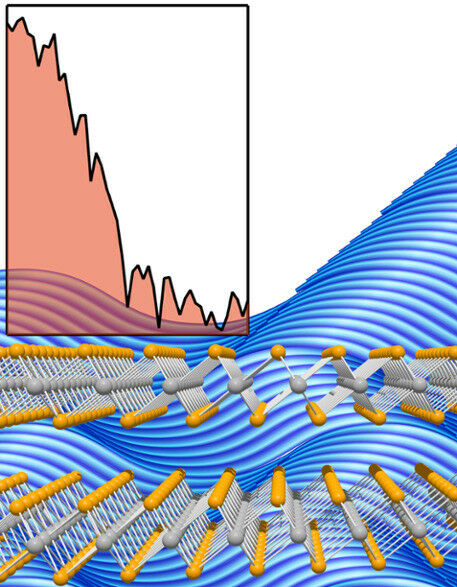
VSe2 is a layered material consisting of vanadium (grey) and selenium (yellow) atoms. As temperature is decreased, the material undergoes a phase transition to a charge density wave state. The electron fluid that forms in this state can be made to slosh around under the influence of light. The amplitude of this motion increases as temperature is lowered (red area).
VSe2 is a layered material consisting of vanadium (grey) and selenium ( yellow ) atoms. As temperature is decreased, the material undergoes a phase transition to a charge density wave state. The electron fluid that forms in this state can be made to slosh around under the influence of light. The amplitude of this motion increases as temperature is lowered (red area) . In the latest edition of Physical Review B, UvA PhD candidate Xuanbo Feng (QuSoft and IoP) and colleagues write about their recent experiments on a material that can go from a normal metal state to a more exotic state known as a 'charge density wave state'. The article was selected by the editors as an Editor's Suggestion. The material is a transition-metal dichalcogenide , VSe2, so named as it is made from elements from the transition-metal row and chalcogenide column of the periodic table.
TO READ THIS ARTICLE, CREATE YOUR ACCOUNT
And extend your reading, free of charge and with no commitment.