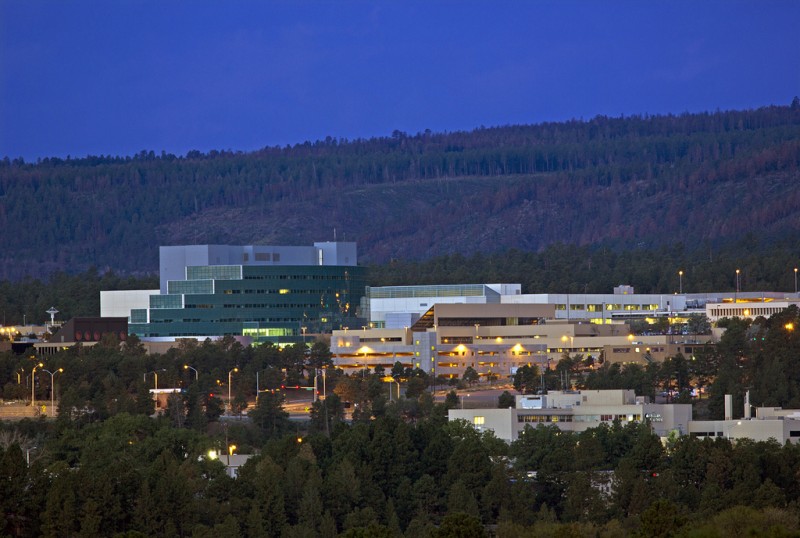
Los Alamos National Laboratory sits on top of a once-remote mesa in northern New Mexico with the Jemez mountains as a backdrop to research and innovation covering multi-disciplines from bioscience, sustainable energy sources, to plasma physics and new materials.
Los Alamos will be home to two new Energy Frontier Research Centers through a five-year funding commitment by DOE. LOS ALAMOS, New Mexico, May 12, 2009—Solarand nuclear-energy technology advancements from Los Alamos National Laboratory (LANL) could help the nation in its quest to capture viable sources of alternative energy, thanks to funding from the U.S. Department of Energy's Office of Science. Los Alamos will be home to two new Energy Frontier Research Centers (EFRCs)—each designed to advance scientific research in alternative and renewable energy—through a five-year funding commitment by DOE. Forty-six such centers will be established nationwide at national laboratories, universities, nonprofit organizations, and private firms. The two LANL centers each will receive $3.8 million a year in funding ($19 million each total over the five-year term). One center, led by Los Alamos National Laboratory Fellow Victor Klimov, will focus on exploiting the physical properties of nanomaterials (compilations of structures so tiny they can't be seen by the human eye) to more efficiently convert solar energy into electric power, or develop materials such as highly efficient solar collectors that could be painted onto a surface to generate electricity. At the center of this research are quantum dots, extremely tiny semi-conducting materials with the ability to generate more than one electrical-energy unit (electron) per single light unit (photon)—an improvement over today's solar cells.
TO READ THIS ARTICLE, CREATE YOUR ACCOUNT
And extend your reading, free of charge and with no commitment.