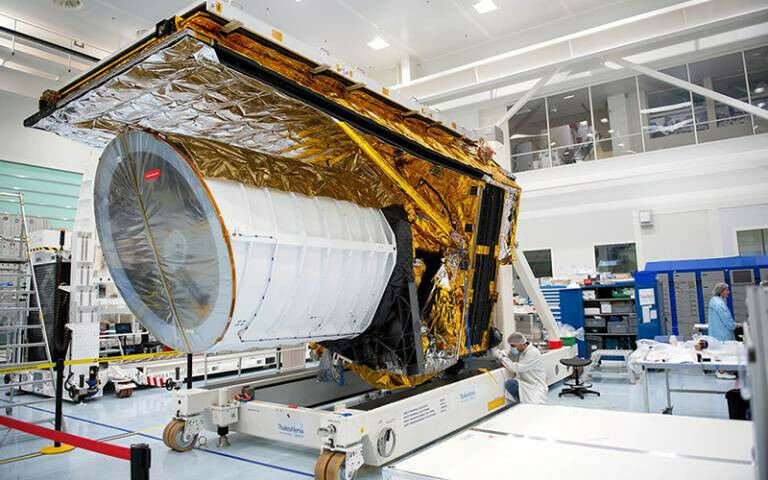
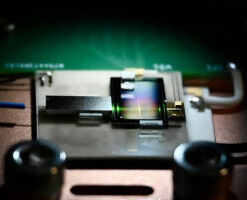
A replica of Euclid in a laboratory in Cannes.
A replica of Euclid in a laboratory in Cannes. Euclid, a space mission led by the European Space Agency that includes a massive optical camera designed and built by UCL researchers, will map the large-scale structures of the universe to better understand two mysterious components: dark matter and dark energy. Everything that we can see and detect in the world around us - the stars, galaxies, flowers, our bodies, atoms - represents just 5% of the universe. The rest of it, according to current theories, is made up of two components: dark matter and dark energy. Their existence is inferred indirectly. Dark matter keeps galaxies together; dark energy is hastening the expansion of the universe. But what they are is unknown.
TO READ THIS ARTICLE, CREATE YOUR ACCOUNT
And extend your reading, free of charge and with no commitment.