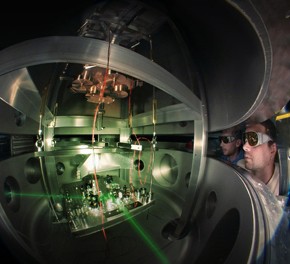
ANU researchers carrying out a related gravity wave experiment
The detection of gravitational waves has taken a leap forward with an announcement by researchers from the multi-national LIGO Scientific Collaboration, published today in specialist. The paper outlines how scientists used a quantum physics instrument, based on a design by The Australian National University, to squeeze light, which resulted in 50 per cent more accuracy from one of their interferometers. Interferometers measure gravitational waves with such sensitivity that a particular quantum phenomenon of light - shot noise - limits the measuring accuracy. Leader of the Collaboration's Quantum Noise Working Group Professor McClelland from ANU said that measuring at the limits of the laws of nature was a major challenge in the search for gravitational waves. "By using a new type of laser light, so-called squeezed light, the team has dramatically increased the sensitivity of the 600m long gravitational wave sensor GEO600 in Hannover, Germany," he said. "This is the first time this technology has been used outside of a test laboratory anywhere in the world." Gravitational waves, or ripples in the curvature of space-time, were predicted by Einstein over 90 years ago. They are emitted by the most violent events in the Universe including black hole collisions, supernovae and the Big Bang itself.
TO READ THIS ARTICLE, CREATE YOUR ACCOUNT
And extend your reading, free of charge and with no commitment.