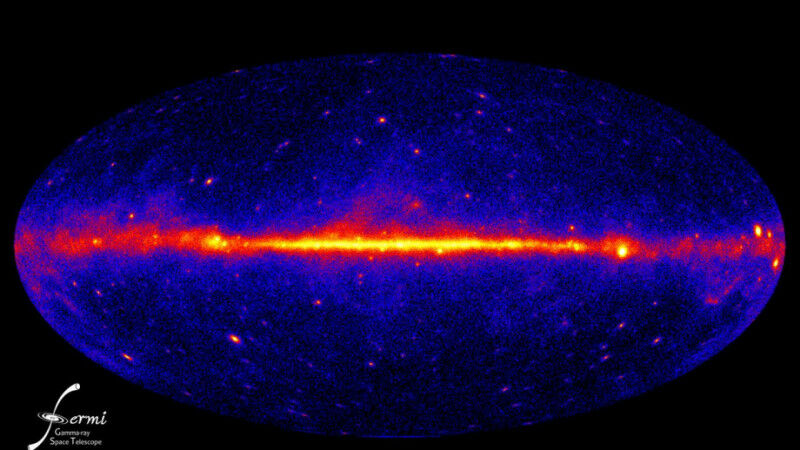
View of the gamma-ray sky. Image: NASA/DOE/Fermi LAT Collaboration
View of the gamma-ray sky. Image: NASA/DOE/Fermi LAT Collaboration - Researchers from The Australian National University (ANU) have found an alternative explanation for a mysterious gamma-ray signal coming from the centre of the galaxy, which was long claimed as a signature of dark matter. Gamma - rays are the form of electromagnetic radiation with the shortest wavelength and highest energy. Co-author of the study Associate Professor Roland Crocker said th is particular gamma-ray signal - known as the Galactic Centre Excess - may actually come from a specific type of rapidly-rotating neutron star , the super-dense stellar remnants of some stars much more massive than our sun. The Galactic Centre Excess is an unexpected concentration of gamma - rays emerging from the centre of our galaxy that has long puzzled astronomers. "Our work does not throw any doubt on the existence of the signal, but offers another potential source," Associate Professor Crocker said. "It is based on millisecond pulsars - neutron stars that spin really quickly - around 100 times a second.
TO READ THIS ARTICLE, CREATE YOUR ACCOUNT
And extend your reading, free of charge and with no commitment.