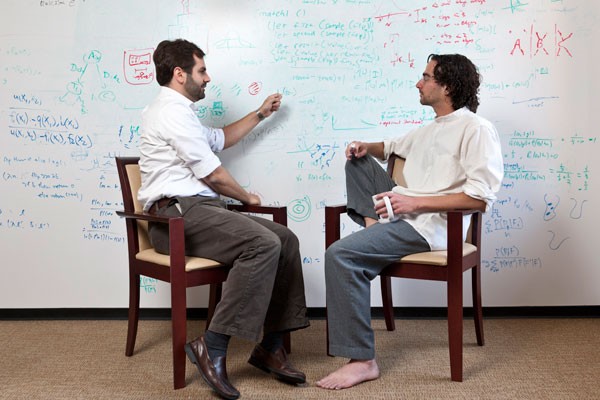
Noah Goodman, right, and Michael Frank, both assistant s of psychology, discuss their research at the white board that covers the wall in Goodman’s office.
In a new paper, the researchers describe a mathematical model they created that helps predict pragmatic reasoning and may eventually lead to the manufacture of machines that can better understand inference, context and social rules. Language is so much more than a string of words. To understand what someone means, you need context. Consider the phrase, "Man on first." It doesn't make much sense unless you're at a baseball game. Or imagine a sign outside a children's boutique that reads, "Baby sale - One week only!" You easily infer from the situation that the store isn't selling babies but advertising bargains on gear for them. Present these widely quoted scenarios to a computer, however, and there would likely be a communication breakdown. Computers aren't very good at pragmatics - how language is used in social situations.
TO READ THIS ARTICLE, CREATE YOUR ACCOUNT
And extend your reading, free of charge and with no commitment.