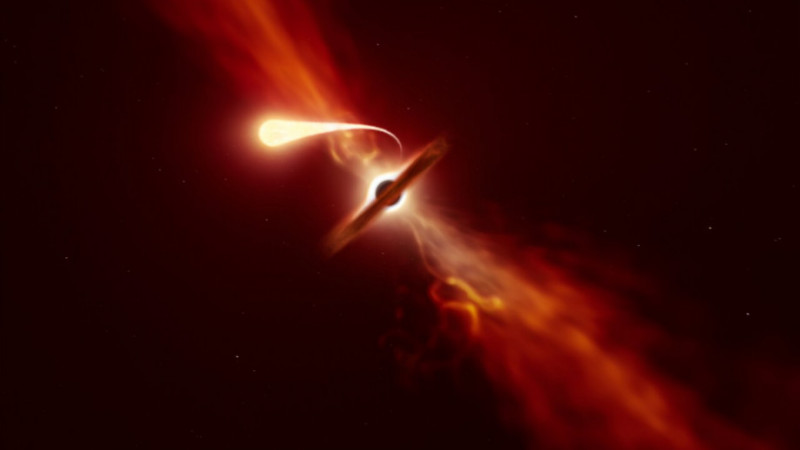
This illustration depicts a star (in the foreground) experiencing spaghettification as it’s sucked in by a supermassive black hole (in the background) during a ’tidal disruption event’. Credit: ESO/M. Kornmesser
This illustration depicts a star (in the foreground) experiencing spaghettification as it's sucked in by a supermassive black hole (in the background) during a 'tidal disruption event'. Credit: ESO/M. Kornmesser - Astronomers have spotted a rare phenomenon - a star being ripped apart by a supermassive black hole in a process called "spaghettification". The event, known as a "tidal disruption", was detected using telescopes from the European Southern Observatory (ESO), and is the closest flare of its kind ever recorded, at just over 215 million light years from Earth. According to Dr Brad Tucker from The Australian National University (ANU), who was part of the research team, black holes are famous for "ripping things apart" by spaghettification. This happens when the extreme gravitational pull of the black hole shreds the star into thin streams of material. As some of this material falls into the black hole, a bright flare of energy is released. "These events are rare, and hard to spot.
TO READ THIS ARTICLE, CREATE YOUR ACCOUNT
And extend your reading, free of charge and with no commitment.