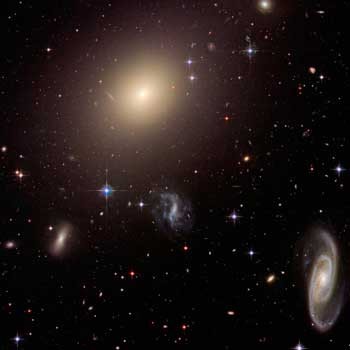
A picture of the Abell Cluster taken using the Hubble Space Telescope (Credit: NASA/ESA and the Hubble Heritage Team). The picture encapsulates the diversity in galaxy types observed in our Universe.
Scientists at UCL and Cambridge have developed a computer program modelled on the human brain that can recognise the shape of galaxies and classify them accurately and efficiently. There are billions of galaxies in the Universe, containing anything between ten million and a trillion stars. They display a wide range of shapes, from elliptical and spiral to much more irregular systems. Large observational projects - such as the Sloan Digital Sky Survey - are mapping and imaging a vast number of galaxies. The first step of that process involves classifying the types of galaxies within these large samples. The 250,000 members of the public participating in the Galaxy Zoo project recently classified 60 million such galaxies by eye. Now, a team of astronomers has used Galaxy Zoo classifications to train a computer algorithm known as an artificial neural network to recognise the different types of galaxy.
TO READ THIS ARTICLE, CREATE YOUR ACCOUNT
And extend your reading, free of charge and with no commitment.