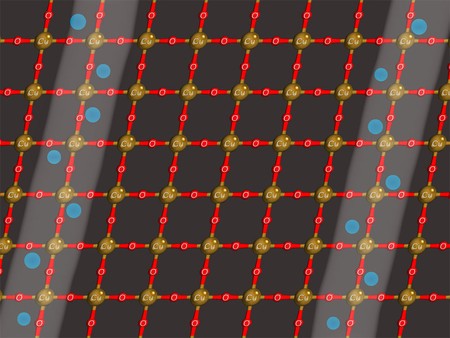
Illustration shows "rivers of charge" in a copper-based superconducting material. The blue circles represent charges.
Imagine phones and laptops that never heat up or power grids that never lose energy. This is the dream of scientists working with so-called high-temperature superconductors, which can effortlessly carry electrical currents with no resistance. The first high-temperature superconducting materials, called cuprates, were discovered in the 1980s and would later be the subject of a Nobel Prize. The term "high-temperature" is relative-these materials operate at frosty temperatures of up to minus 135 degrees Celsius, a bit higher than their traditional counterparts, which work at even chillier temperatures near absolute zero (minus 273 degrees Celsius). Despite the fact that high-temperature superconductors were discovered three decades ago, researchers are still scratching their heads over how the materials work. Scientists know that the answer is related to electrons sticking together in pairs, as if glued together, but the nature of the electron "glue" that binds them is unknown. Pinpointing the glue could ultimately lead to the creation of room-temperature superconducting materials and pave the way for energy-saving computers and a host of other innovations, such as levitating trains.
TO READ THIS ARTICLE, CREATE YOUR ACCOUNT
And extend your reading, free of charge and with no commitment.