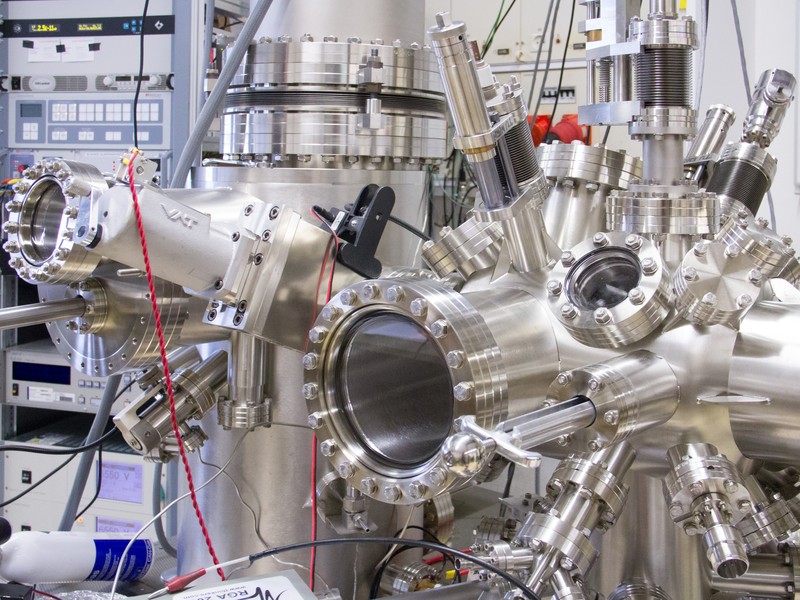
Kraftmikroskop an der TU Wien
At TU Wien (Vienna), it has become possible to control one of the most important chemical processes: switching oxygen molecules between a reactive and unreactive state. Oxygen atoms are highly reactive, yet the world does not spontaneously burn, even though everything is surrounded by this aggressive element. Why? The reason is that normal O2 molecules, are not particularly reactive. At the Vienna University of Technology, it has now been possible to selectively switch individual oxygen molecules sitting on a titanium oxide surface between a non-reactive to a reactive state using a special force microscope. This process was viewed for the first time in high-resolution images. Activation: Heat, or Electrons - "There are several ways to switch a stable, non-reactive O2 molecule into a reactive state," explains Martin Setvin, a member of the research group of Prof. Ulrike Diebold at the Institute for Applied Physics at the Vienna University of Technology. "You can increase the temperature - that happens when you burn things.
TO READ THIS ARTICLE, CREATE YOUR ACCOUNT
And extend your reading, free of charge and with no commitment.