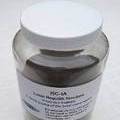
Simulated lunar regolith
Testing Mars and Moon soil for sheltering astronauts from radiation Humans venturing beyond Earth orbit deeper into space face increased exposure to cosmic radiation, so ESA has teamed with Germany's GSI particle accelerator to test potential shielding for astronauts, including Moon and Mars soil. ESA's two-year project is assessing the most promising materials for shielding future astronauts going to the Moon, the asteroids or Mars. "We are working with the only facility in Europe capable of simulating the high-energy heavy atomic nuclei found in galactic cosmic radiation - the GSI Helmholtz Centre for Heavy Ion Research in Darmstadt, Germany," explained Alessandra Menicucci, overseeing the project. "We assessed materials including aluminium, water, polyethylene plastic, multilayer structures and simulated Moon and Mars material - the latter on the basis these will be accessible to planetary expeditions. "We have also confirmed a new type of hydrogen storage material holds particular promise." - Space is awash with charged particles, meaning that astronauts are officially classed as radiation workers. The International Space Station orbits within Earth's magnetic field, safeguarding its occupants from the bulk of space radiation. To venture further out, dedicated shielding will be required.
TO READ THIS ARTICLE, CREATE YOUR ACCOUNT
And extend your reading, free of charge and with no commitment.