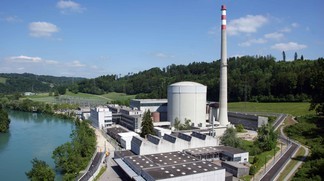
 The Mühleberg nuclear power plant
Gaëtan Girardin, researcher in nuclear engineering, gives us the key to understanding nuclear reactor safety. While the disaster at Fukushima is at the center of our conversation, the recent and minor incident at the Mühleberg plant is also discussed. February the 8th at 1:45 p.m., the nuclear reactor at Mühleberg automatically stopped upon detection of an anomaly. Although not frequent, such events are not exceptional. Gaëtan Girardin, a researcher in nuclear engineering and head of the Crocus reactor at EPFL, will participate on February 22nd in "Science! On tourne"—a series of public dialogues about science. The first lecture is entitled "One Year Later: has Fukushima really changed the game?" He provides us with some techniques to better understand the operation of nuclear plants and, more particularly, the shutdown procedure that was made impossible in Japan. After Fukushima, people have realized that shutting down a nuclear reactor is not as simple as turning out the lights. Things are a little more complex. Gaëtan Girardin: That is correct; we need to stop a chain reaction. A nuclear reactor is a tank filled with metal bars about the diameter of a pen that contain uranium. This is the nuclear fuel itself. As it decays, the uranium nucleus releases neutrons, which will collide with its neighbors, and so on. The heat produced by the fission reactions will be used to produce steam, which then turn an electric turbine. This is common to all power plants. To stop the reactor, that is to say to stop the chain reaction, we must act on the production of neutrons, or capture them. Specifically, how does one proceed?
TO READ THIS ARTICLE, CREATE YOUR ACCOUNT
And extend your reading, free of charge and with no commitment.
Your Benefits
- Access to all content
- Receive newsmails for news and jobs
- Post ads