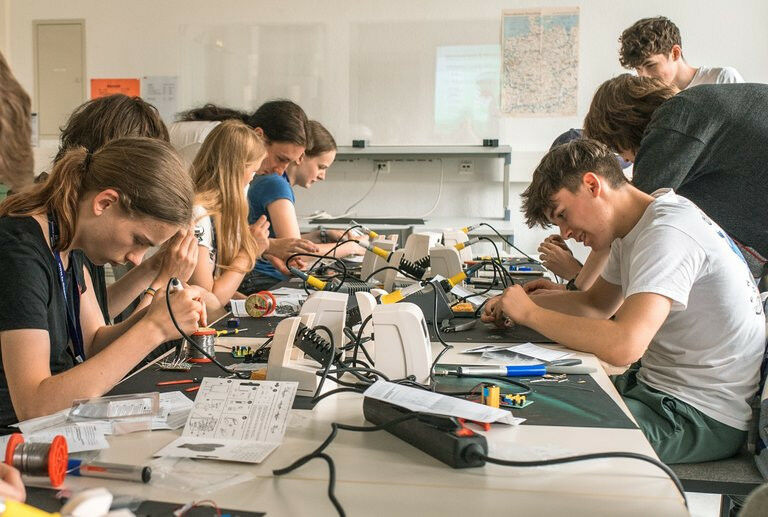
Zum Auftakt des Camps nahmen die Teilnehmenden an einem interdisziplinären Workshop zum Löten und Programmieren mit Arduino teil
Zum Auftakt des Camps nahmen die Teilnehmenden an einem interdisziplinären Workshop zum Löten und Programmieren mit Arduino teil - Whether photovoltaics, geothermal energy, electrolysis for water splitting or a self-built wind turbine: At a four-day Science Camp at the TU Ilmenau, 20 students from the national Excellence School Network MINT-EC dealt with various aspects of energy supply from June 19 to 22. In small groups and supported by staff and student tutors, they explored from various technical perspectives how we can use our energy resources optimally and responsibly in the future. 16-year-old Liliana traveled from near Münster to attend the MINT-EC camp at TU Ilmenau: "Having to research something from scratch, designing it and seeing how the project slowly develops - I find that super interesting." As with other camps before, as a student from a MINT-EC school, she wanted to take advantage of the opportunity to conduct in-depth research on a STEM topic with a hands-on mentality over the course of several days, deepening her school knowledge through real-world problems from research and the workplace. "But this camp was different from the other two I've been to," Liliana said: This time we got a really big project to work on and really get into. So the time just flew by. As a prelude, Liliana and the other participants first received an interdisciplinary workshop on soldering and programming with Arduino by students in the practicING project. Dr. Jan Schnabel from the Fraunhofer Institute for Manufacturing Engineering and Automation in Stuttgart also introduced the young people to the topic of energy supply with a lecture on the "Application of quantum computing in hydrogen research".
TO READ THIS ARTICLE, CREATE YOUR ACCOUNT
And extend your reading, free of charge and with no commitment.