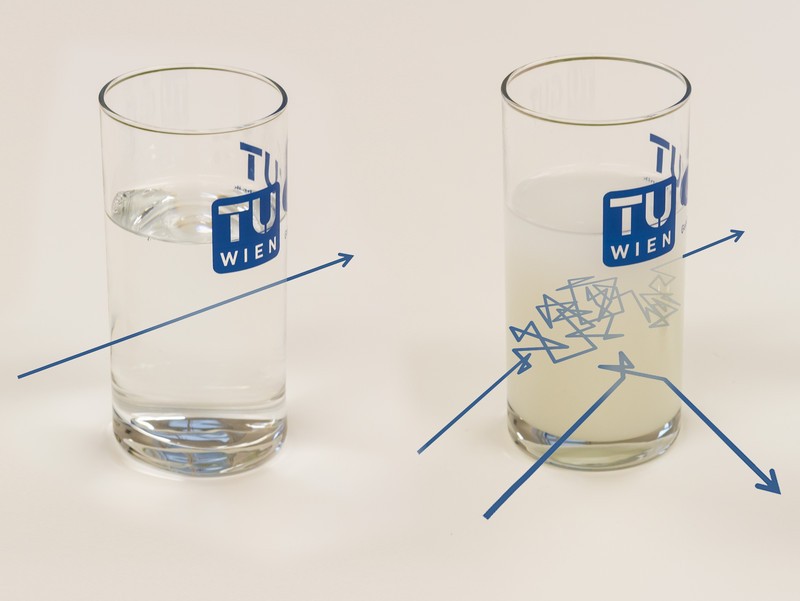
Licht auf dem Weg durch eine Flüssigkeit: Im Falle einer transparenten Flüssigkeit (links) sind Lichtpfade geradlinig. Im Falle einer Trübung durch Nanopartikel (rechts) werden Lichtpfade durch Streuung komplizierter. Manche der Pfade werden dadurch länger
A seemingly paradoxical prediction in physics has now been confirmed in an experiment: No matter whether an object is opaque or transparent, the average length of the light's paths through the object is always the same. Light on its way through a liquid: In case of a transparent liquid (left) light paths are straight lines. In case the liquid is made opaque through nanoparticles (right) light paths get more complicated through scattering. Some of the paths become longer, others shorter - on average though the length of light paths is the same as in the transparent case. Simulation results for light paths in circular areas with different degrees of opacity. Light comes in from the left with many different injection angles. Image credit: Romain Pierret & Romolo Savo.
TO READ THIS ARTICLE, CREATE YOUR ACCOUNT
And extend your reading, free of charge and with no commitment.