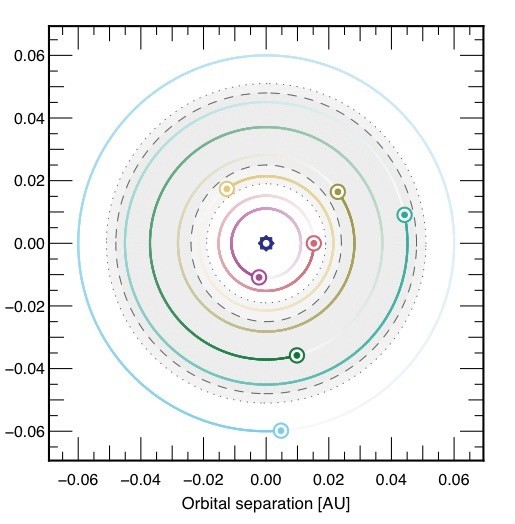
The orbits of the seven planets around the star TRAPPIST-1. The grey region is the zone, where liquid water could exist on the surface of the planets. On planet TRAPPIST-1 h liquid water is possible under a thick layer of ice. (1 AU is the distance between the Sun and the Earth.) Credit: A. Triaud
Media releases, information for representatives of the media Media Relations (E) After 60 hours of non-stop work, researchers at the University of Bern being part of an international team reached their hoped-for goal: They were the first to measure the orbital period for the outermost planet of the famous TRAPPIST-1 system which made headlines worldwide. The new result confirms that the seven Earth-size planets around the ultra-cool dwarf are lined up in a chain with resonances linking every member. "We knew that we had to be very fast to be the first ones", says Marko Sestovic, PhD student at the University of Bern's Center for Space and Habitability (CSH). "If you are not the first, nobody cares about your effort", adds CSH postdoc Simon Grimm. NASA had started the global research race with announcing the public release of data about two months ahead of schedule. Its Kepler Space Telescope had observed the star TRAPPIST-1 from mid-December until early March. Previous observations with telescopes on the ground and in space had revealed that the ultra-cool dwarf is orbited by seven Earth-size planets, a larger number than detected in any other transiting exoplanetary system.
TO READ THIS ARTICLE, CREATE YOUR ACCOUNT
And extend your reading, free of charge and with no commitment.