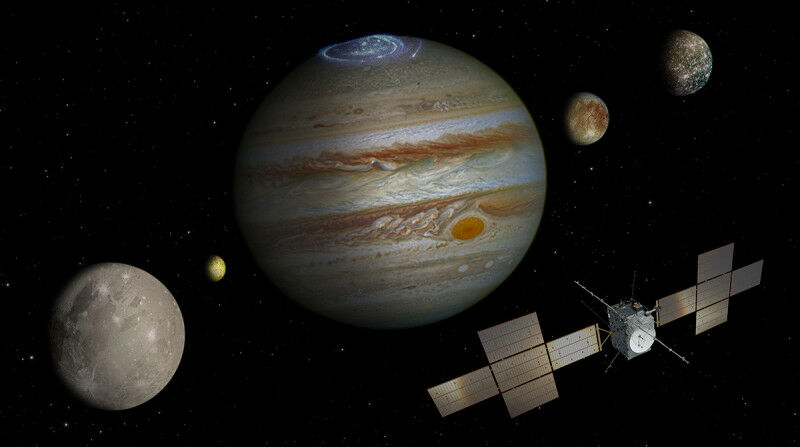
 Artist impression of the Juice mission exploring the Jupiter system. © Spacecraft: ESA/ATG medialab; Jupiter: NASA/ESA/J. Nichols (University of Leicester); Ganymede: NASA/JPL; Io: NASA/JPL/University of Arizona; Callisto and Europa: NASA/JPL/DLR © Spacecraft:
Artist impression of the Juice mission exploring the Jupiter system. Spacecraft: ESA/ATG medialab; Jupiter: NASA/ESA/J. Nichols (University of Leicester); Ganymede: NASA/JPL; Io: NASA/JPL/University of Arizona; Callisto and Europa: NASA/JPL/DLR © Spacecraft: ESA/ATG medialab; Jupiter: NASA/ESA/J. Nichols (University of Leicester); Ganymede: NASA/JPL; Io: NASA/JPL/University of Arizona; Callisto and Europa: NASA/JPL/DLR - The European Space Agency ESA-s Juice space mission is scheduled to start its journey to Jupiter on April 13, 2023. Once arrived, one of the goals of Juice is to search for traces of life on three of Jupiter's icy moons. The University of Bern is contributing the NIM mass spectrometer to the mission and is involved in two other instruments: the SWI Sub-millimeter Wave Instrument and the GALA Laser Altimeter. The European Space Agency ESA's Juice (Jupiter's Icy Moons Explorer) space probe is scheduled to begin its journey to Jupiter on board an ARIANE 5 rocket launched from Europe's Spaceport in Kourou, French Guiana, on Thursday, April 13, 2023 at 2:15 p.m. After a roughly eight-year journey, Juice will arrive at Jupiter to explore the largest planet in our solar system and three of its more than 80 moons.
TO READ THIS ARTICLE, CREATE YOUR ACCOUNT
And extend your reading, free of charge and with no commitment.
Your Benefits
- Access to all content
- Receive newsmails for news and jobs
- Post ads