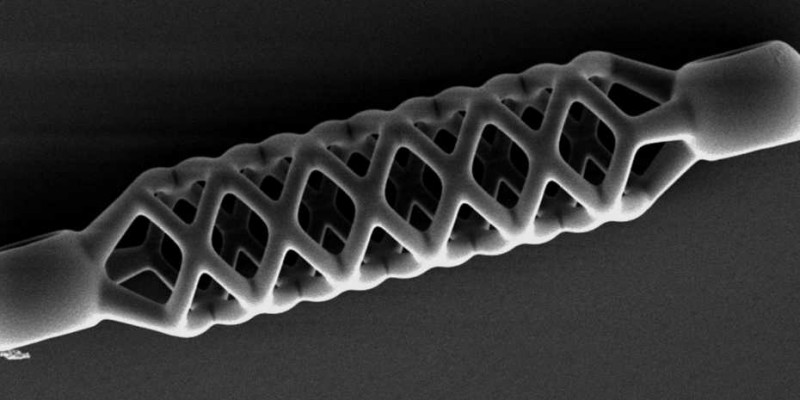
This microstent is just 50 micrometers (0.05 mm) wide and half a millimeter long. (Picture: Carmela de Marco / ETH Zurich)
Researchers at ETH Zurich have developed a new method for producing malleable microstructures ' for instance, vascular stents that are 40 times smaller than previously possible. In the future, such stents could be used to help to widen life-threatening constrictions of the urinary tract in foetuses in the womb. Approximately one in every thousand children develops a urethral stricture, sometimes even when they are still a foetus in the womb. In order to prevent life-threatening levels of urine from accumulating in the bladder, paediatric surgeons like Gaston De Bernardis at the Kantonsspital Aarau have to surgically remove the affected section of the urethra and sew the open ends of the tube back together again. It would be less damaging to the kidneys, however, if a stent could be inserted to widen the constriction while the foetus is still in the womb. Stents have been used to treat blocked coronary vessels for some time now, but the urinary tract in foetuses is much narrower in comparison. It's not possible to produce stents with such small dimensions using conventional methods, which is why De Bernardis approached the Multi-Scale Robotics Lab at ETH Zurich.
TO READ THIS ARTICLE, CREATE YOUR ACCOUNT
And extend your reading, free of charge and with no commitment.