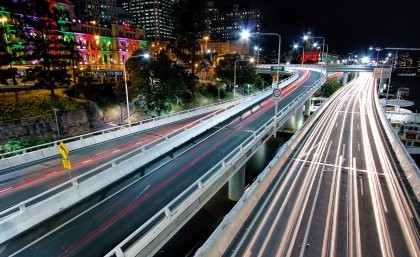
Traffic on Brisbane’s Riverside Expressway
It has been 35 years since globally influential urban planner Professor Michael Batty last visited Brisbane. So what does he make of the changing face of Queensland's capital' A recipient of the Commander of the British Empire, the Nobel de Geographie, and a Fellow of the Royal Society, Professor Batty is in Brisbane to collaborate with University of Queensland School of Earth and Environmental Sciences researchers. Specifically, he is working on a project with Associate Professor Yan Liu to analyse how information from technology such as electronic transport passes can help shape cities of the future. "In the 1950s about 60 to 70 per cent of journeys were between home and work, but now those trips only account for around 10 per cent of journeys," Professor Batty said. "It's much more common now that people will leave work, go to the shop, the gym, out for leisure or another appointment. "There's much greater connectivity between people due to being on text message and social media, which means plans are constantly changing. "We see much greater complexity of movement than we did in past decades, and an extreme amount of data being generated - but how can we make sense of it all?" To exemplify Professor Batty's point, he recalls his last trip to Brisbane in 1982 was mostly organised by hand-delivered mail, and he had a tough job tracking down a relative he wished to visit in New Zealand.
TO READ THIS ARTICLE, CREATE YOUR ACCOUNT
And extend your reading, free of charge and with no commitment.