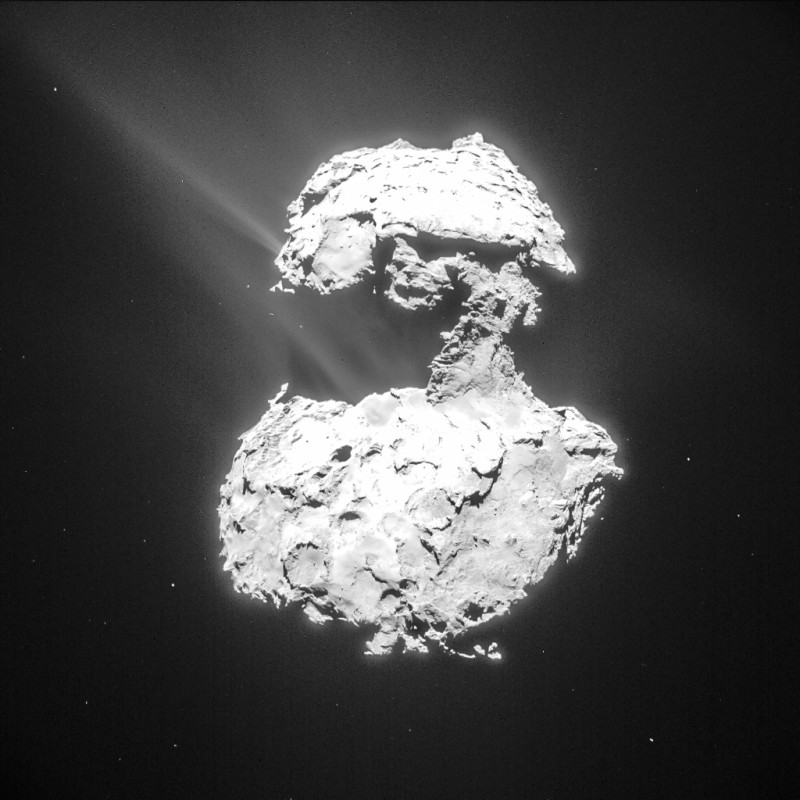
 Gas and dust rise from "Chury’s" surface as the comet approaches the point of its orbit closest to the sun.
On September 30, 2016, the active phase of the ESA's Rosetta mission came to an end with the controlled crash landing of the probe on the surface of the comet Chury. Due to the key experiment of the University of Bern, ROSINA, more information regarding the origin of our solar system was acquired. However, over 2 million data records are still awaiting evaluation. For more than two years, the European Space Agency (ESA)'s Rosetta mission investigated the comet 67P/Churyumov-Gerasimenko—"Chury" for short—in great detail, even placing the Philae landing module on its surface during the process. What's more, it was under the leadership of the University of Bern that the ROSINA (the Rosetta Orbiter Spectrometer for Ion and Neutral Analysis) mass spectrometer was developed, built, tested and operated on the comet via telecommand. ROSINA determined many components of Chury's atmosphere, many of which for the first time on a comet. "The air on the comet would probably be pungent", was the phrase used by Kathrin Altwegg, ROSINA mass spectrometer project leader, to humorously describe the composition of Chury's atmosphere. Water, molecular oxygen and organic compounds. The Rosetta mission was aimed at collecting more information on the origin of our solar system. For example, one of the big questions is how water came to exist on Earth as, in its earliest days, our planet was extremely hot and probably covered with an ocean of lava. Is it possible that comet impacts were responsible for bringing water to Earth at a later date?
TO READ THIS ARTICLE, CREATE YOUR ACCOUNT
And extend your reading, free of charge and with no commitment.
Your Benefits
- Access to all content
- Receive newsmails for news and jobs
- Post ads