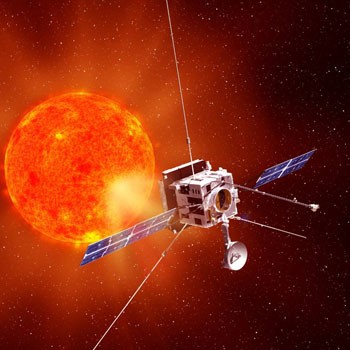
A computer-generated image of the Solar Orbiter (credit: ESA).
UCL looks set to play a central role in three new space missions designed to unlock the secrets of the Sun, search for dark matter, and seek out planets that could harbour life. The UK Space Agency has just awarded £3.65m to help scientists prepare for the missions, Solar Orbiter, Euclid, and PLATO, and UCL is involved in all of them. The missions are part of ESA's Cosmic Vision programme and have been selected from more than 50 original ideas to go forward for detailed technical and cost assessments. Solar Orbiter is designed to travel closer to our own star than any previous Sun-watching mission. It would use an elliptical orbit to take it up to the Sun's higher latitudes to image, for the first time ever, the polar regions of our star. This special path would also allow Solar Orbiter to keep pace with the Sun's rotation so that it could track specific features below it for several weeks at a time. As it travels around the Sun, bombarded by the solar wind, Solar Orbiter will carry out in-depth studies of the connections between the Sun and space and could provide major breakthroughs in our understanding of how the inner Solar System works and is driven by solar activity.
TO READ THIS ARTICLE, CREATE YOUR ACCOUNT
And extend your reading, free of charge and with no commitment.