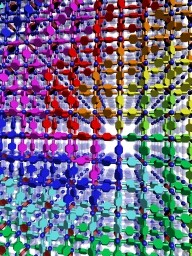
Image of 3-D, synthetic DNA-like crystals created by Yaghi, Deng and colleagues
UCLA chemists report creating a synthetic "gene" that could capture heat-trapping carbon dioxide emissions, which contribute to global warming, rising sea levels and the increased acidity of oceans. "We created three-dimensional, synthetic DNA-like crystals," said UCLA chemistry and biochemistry professor Omar M. Yaghi, who is a member of the California NanoSystems Institute (CNSI) at UCLA and the UCLA-Department of Energy Institute of Genomics and Proteomics. "We have taken organic and inorganic units and combined them into a synthetic crystal which codes information in a DNA-like manner. It is by no means as sophisticated as DNA, but it is certainly new in chemistry and materials science." The discovery could lead to cleaner energy, including technology that factories and cars can use to capture carbon dioxide before it reaches the atmosphere. "What we think this will be important for is potentially getting to a viable carbon dioxide-capture material with ultra-high selectivity," said Yaghi, who holds UCLA's Irving and Jean Stone Chair in Physical Sciences and is director of the CNSI's Center for Reticular Chemistry. "I am optimistic that is within our reach. Potentially, we could create a material that can convert carbon dioxide into a fuel, or a material that can separate carbon dioxide with greater efficiency." The research was federally funded by the U.S. Department of Energy's Office of Basic Energy Sciences. The lead author is Hexiang "DJ" Deng, a UCLA graduate student of chemistry and biochemistry who works in Yaghi's laboratory. "DNA is a beautiful molecule that has a way to code for information," Yaghi said. "How do you code information in a crystal in the same way that DNA does?
TO READ THIS ARTICLE, CREATE YOUR ACCOUNT
And extend your reading, free of charge and with no commitment.