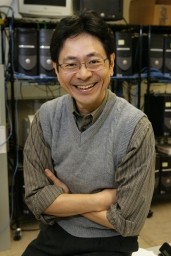
UCLA physics professor and dark matter researcher Katsushi Arisaka
Dark matter, for more than 70 years as mysterious and unknowable a subject to science as the legendary island of Atlantis has been to history, is bringing 140 scientists from the U.S. Europe and Asia to the Marriott Hotel in Marina del Rey for the ninth UCLA Symposium on Sources and Detection of Dark Matter and Dark Energy in the Universe . The three-day conference runs through Friday, Feb. 26. "Dark matter is one of the last great frontiers in science," said David B. Cline, UCLA professor of physics, high-energy astrophysicist and symposium organizer. "Once we know what it really is, we will break through into a new realm of nature. It's going to be an entirely new era for science, it's going to pose fascinating new questions, it's going to be exciting." First proposed in the 1930s by the late California Institute of Technology scientist Fritz Zwicky to explain why some galaxies appeared more ponderous than their luminosity would suggest, dark matter is thought to account for almost 25 percent of the universe today. Just 5 percent is made up of visible, tangible matter; the remaining 70 percent is in the equally baffling form of dark energy.
TO READ THIS ARTICLE, CREATE YOUR ACCOUNT
And extend your reading, free of charge and with no commitment.