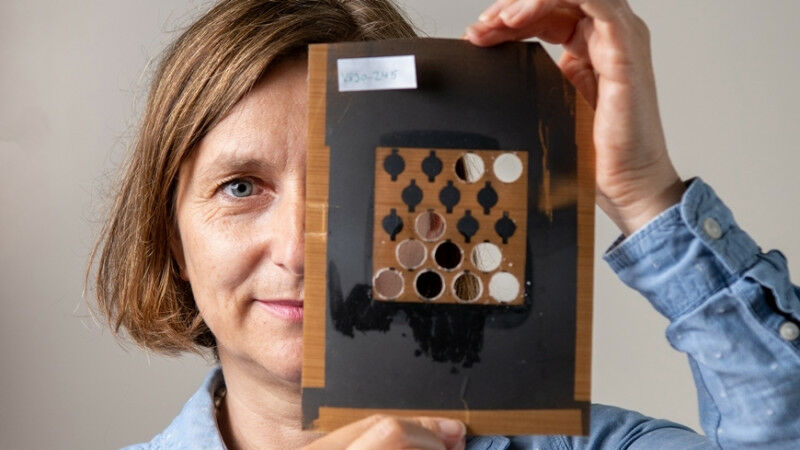
Dorina Opris and very thin components for die-cutting: Conductive layers printed with carbon-based ink are later sandwiched between layers of polysiloxane. Image: Empa
Dorina Opris and very thin components for die-cutting: Conductive layers printed with carbon-based ink are later sandwiched between layers of polysiloxane. Image: Empa At Empa, Dorina Opris is researching how to synthesize complex electroactive polymers for robotic components, sensors or batteries - a promising project that the European Research Council (ERC) is currently funding with one of its prestigious ERC Consolidator Grants. This is not the chemist's first success - but the road that led to it wasn't all that easy. At first glance, the career of Dorina Opris, born in 1974, seems like a picture-book one: from studying chemistry at Babes-Bolyai University in Cluj, Romania, to the Free University of Berlin, to becoming a titular professor at ETH Zurich and head of the Functional Polymeric Materials research group at Empa - funded by an ERC Consolidator Grant worth around two million euros. All this with a family and the joys, worries, and duties of two children. How does this work? With talent that was recognized and encouraged early on - even as a student in Transylvania. With a diverse education - not only in theory, but also in laboratory practice, which Opris misses in some of her students in Switzerland.
TO READ THIS ARTICLE, CREATE YOUR ACCOUNT
And extend your reading, free of charge and with no commitment.