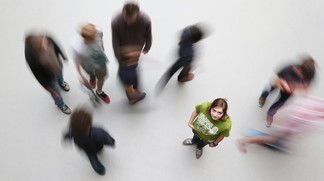
SUMMER SERIES (4) - For her semester project, an EPFL Master's student applied a different approach to tracking the flow of the crowds at the Paléo music festival - using cell phone data and statistics. Tracking individuals in a large group, be they ants or humans, is no trivial task. By applying statistics to mobile phone signals picked up in a large crowd, Master's student Elisaveta Kondratieva developed a way to more accurately follow and understand the behavior of the individuals that make up the crowd, revealing the potential and the pitfalls of this new approach. For her semester project, she evaluated an extensive dataset gathered at the 2010 Paléo music festival in a campaign entirely planned and carried out by researchers in the research groups of Patrick Thiran and Martin Vetterli in collaboration with Olivier Dousse at Nokia. Every year, the Paléo music festival attracts well over 40,000 music aficionados per day. Many carry mobile phones with activated bluetooth devices. In 2010, ten "agents" were part of the crowd, equipped with special mobile phones programmed to pick up and store the identity of all detectable bluetooth devices in their vicinity. The data they gathered provides a list of all of the detectable bluetooth devices surrounding each of the walking agents at any given time throughout the evening. Often, these data are not enough to discriminate between different nearby locations. Were the detected individuals at the Asian food stall, the stand right next to it, or were they on the way to their next concert?
TO READ THIS ARTICLE, CREATE YOUR ACCOUNT
And extend your reading, free of charge and with no commitment.
Your Benefits
- Access to all content
- Receive newsmails for news and jobs
- Post ads