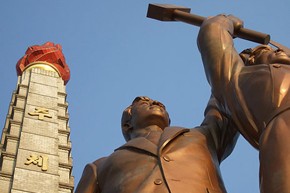
The Juche Tower, completed in 1982 to commemorate Kim Il Sung’s seventieth birthday. In front stands a statue of the idealised worker, farmer and intellectual, holding up the hammer, sickle and brush respectively. Photo: Will De Freitas/ Flickr
Relations are unlikely to be warm, but dealings with the North can be handled calmly, writes Danielle Chubb. North Korea?watching is a peculiar pastime. More than a decade and a half ago, esteemed North Korea specialists were confidently predicting the demise of the Kim Jong Il regime, following the death of his powerful and revered father, Kim Il Sung. Today, however, it's hard to find anyone willing to make a firm statement regarding the future of the regime. North Korea survived once against all the odds ' the death of Kim Il Sung coinciding with a fall in financial support from the Soviet Union at the end of the Cold War and a series of natural disasters - and the rest of the world learnt an important lesson: this is a country whose continued existence needs to be taken seriously. The secretive manner in which North Korea conducts its international affairs leads to intense speculation about the country's domestic conditions, motives and goals. The most recent provocations have been no exception, and they raise the question: how best to understand them? As is so often the case, the strikes on Yeongpyeong Island, the most recent in a series of provocative acts by the North Koreans, were aimed at two separate audiences, domestic and international.
TO READ THIS ARTICLE, CREATE YOUR ACCOUNT
And extend your reading, free of charge and with no commitment.