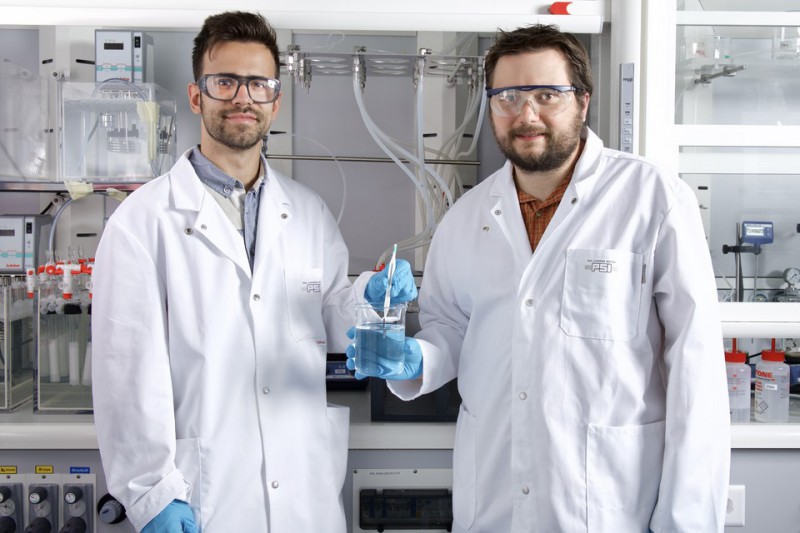
PSI researchers Antoni Forner-Cuenca (left) and Pierre Boillat in the laboratory, where they developed and tested parts of the new coating technique. (Photo: Paul Scherrer Institut/Markus Fischer)
Researchers have developed a coating technique in the laboratory conditions that could raise the efficiency of fuel cells. The scientists have already applied to patent the technique, which is suitable for mass production. Researchers from the Paul Scherrer Institute (PSI) have developed a coating technique in the laboratory that could raise the efficiency of fuel cells. Fuel cells generate electricity from hydrogen and oxygen. The gases are transported to the cell's electrodes from the outside. However, on their way to the electrodes, the gases encounter liquid water that is produced constantly in the fuel cell and should flow out of the cell. When too much water accumulates, the gases flow more slowly, thus limiting the generation of electricity. "Our newly developed coating ensures that the liquid water and the gases flow through the porous materials in the fuel cells using separate channels. This improves the performance and the stability of the fuel cells", says the head of the study, Pierre Boillat from the Electrochemistry Laboratory at PSI. Fuel cells convert the chemical energy contained in the gases into electricity. The electricity produced can be used, for example, to power an electric car. The only chemical product of the reactions taking place in fuel cells is water. The "exhaust gas" of a fuel cell car thus only contains harmless water vapour. Fuel cell cars ready for series production have been available since 2013. Water limits electricity output
TO READ THIS ARTICLE, CREATE YOUR ACCOUNT
And extend your reading, free of charge and with no commitment.