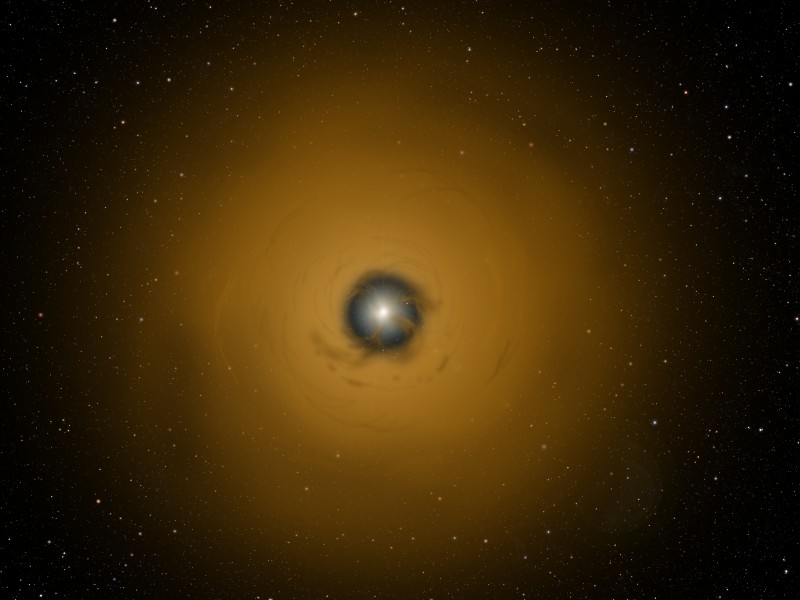
TW Hydrae system
Indianapolis, IN - If you had a time machine that could take you anywhere in the past, what time would you choose? Most people would probably pick the era of the dinosaurs in hopes of spotting a T. rex. But many astronomers would choose the period, four and a half billion years ago, that our solar system formed. In lieu of a working time machine, we learn about the birth of our Sun and its planets by studying young stars in our galaxy. New work suggests that our Sun was both active and "feisty" in its infancy, growing in fits and starts while burping out bursts of X-rays. "By studying TW Hydrae, we can watch what happened to our Sun when it was a toddler," said Nancy Brickhouse of the Harvard-Smithsonian Center for Astrophysics (CfA). She presented the findings today in a press conference at a meeting of the American Astronomical Society. Brickhouse and her colleagues reached this conclusion by studying the young star TW Hydrae, located about 190 light-years from Earth in the southern constellation Hydra the Water Snake.
TO READ THIS ARTICLE, CREATE YOUR ACCOUNT
And extend your reading, free of charge and with no commitment.