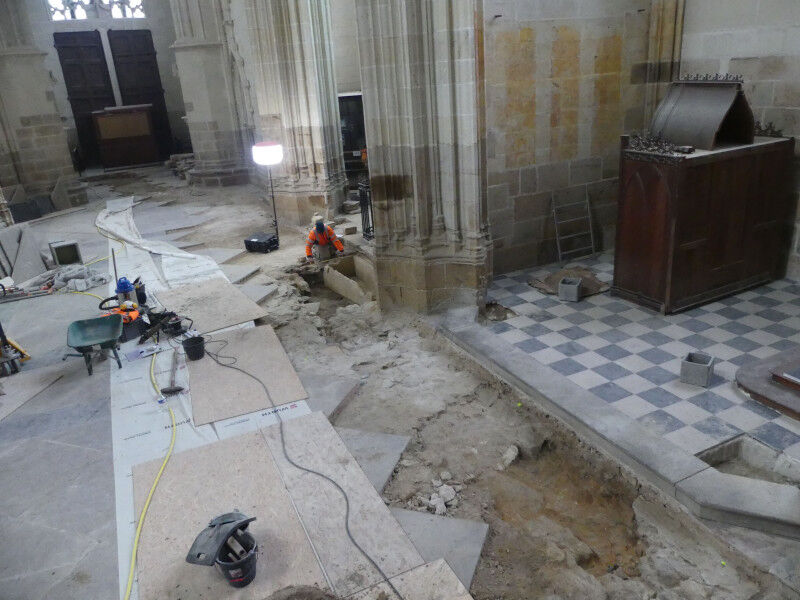
Manual excavation in a trench created to install electrical networks. emmanuelle Collado, Inrap
Since 2023, Inrap archaeologists have worked on several occasions in the Cathedral of Saint-Pierre et Saint-Paul in Nantes, as part of the project to restore the tomb of the Duke of Brittany François II and the Duchess Marguerite de Foix, and more generally as part of the cathedral’s restoration program following the fire on July 18, 2020. To mark the reopening of Nantes Cathedral during the European Heritage Days (September 20 and 21), Inrap archaeologists will be presenting the discoveries made during their work
Photo of the tomb of François II and Marguerite de Foix before dismantling. pymouss - Wikimedia Commons Two excavations, prescribed and financed by the state (Drac des Pays de la Loire / Conservation régionale des Monuments historiques), were carried out: the first in the vicinity of the tomb in the south arm of the transept; the second in a trench cut through the cathedral to install a new electricity network.
The investigations have yielded a wealth of remains (masonry, burials, furniture, architectural elements) and revealed the previously unknown general layout of the Romanesque cathedral. The archaeologists are also involved in the archaeological study of the tomb itself, which has been completely dismantled for restoration, providing an unprecedented insight into this exceptional Renaissance object.
Archaeological study of the ’Jewel of the Cathedral
Inrap’s geophysics unit carried out a georadar survey, an innovative exploration method that reveals the presence of buried remains. This technique consists of emitting a short, high-frequency electromagnetic pulse via an antenna, which propagates at depth and is partially reflected on the interfaces encountered. We then record all the reflected pulses (or echoes), which return during a given time interval. The image generated makes it possible to identify places of resistance (buried walls, for example) and guide the work of archaeologists.
This method complements manual excavation, which is the only way to identify and interpret archaeological structures.
Excavations reveal the layout of the Romanesque cathedral
Until now, only the crypt, which is still visible, and the choir depicted in old engravings and photographs could be attributed with certainty to the Romanesque period. Thanks to the excavations, a series of Romanesque masonries have now been uncovered. The archaeological data also made it possible to locate the Romanesque west portal, to draw a precise complete plan and to perceive the scale of a cathedral that was never completed. In this way, archaeological research has shed new light on the cathedral’s history.
Archaeological furniture, painted plaster and burials
Excavations carried out within the cathedral in the south transept and in the trench dug for the electricity network have yielded a wide variety of archaeological finds: architectural elements, ceramics, metal and stone objects, coins, terracotta floor tiles, painted decorations on the walls, and more. These remains will be studied by various specialists. Archaeologists have also uncovered four isolated burials and three burial vaults containing numerous bones.
Painted plaster with floral motif discovered on the south wall of the cathedral. caroline Chauveau, Inrap Coupled with a documentary study, an anthropological study will attempt to clarify the status of the deceased (lay or ecclesiastical, illustrious or canons) and to assess the health of the buried population, as well as to identify the spatial organization of this space and funerary practices. Archival research will complete this study phase, providing a history of the Romanesque cathedral and its architectural evolution.
European Heritage Days on September 20 and 21
on the occasion of the European Heritage Days, Inrap archaeologists will be working alongside government departments, restorers and the Lefèvre company to present their work and major discoveries to the general public, in the form of presentations and events.