Extreme and prolonged droughts jeopardize the stability of ecosystems worldwide. An international study in Science shows that their productivity declines further with each year of drought. BFH-HAFL was the only Swiss institution involved, providing data and contributing important findings from a Central European grassland.
Droughts are among the most serious disturbances in ecosystems. Multi-year periods of drought cause enormous damage, both ecologically and economically. As extreme droughts are expected to become more frequent with climate change, researchers around the world wanted to find out more about their consequences.
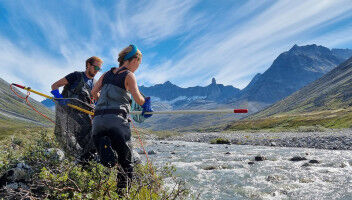
In a study now published in Science, they analyzed data from 74 grasslands and shrublands on six continents worldwide. The big question: do ecosystems adapt to prolonged drought - i.e. stabilize their function - or do they become increasingly weakened over time? Until now, the scientific answers have been inconclusive. The basis for this was the International Drought Experiment (IDE), a multi-year global study on the effects of drought on plant production, which indicates the performance of ecosystems. The BFH-HAFL School of Agricultural, Forest and Food Sciences is the only Swiss institution to contribute data.
Remarkable results
In general, the results are clear: the longer and more intense droughts last, the more ecosystems suffer. However, it also shows that ’many of the habitats can adapt to dry periods lasting several years after an initial loss of productivity’, says Andreas Stampfli from BFH-HAFL. It is remarkable that some of the sites studied showed hardly any changes in their productivity even after several consecutive years of drought.
Stampfli: ’These are less water-limited ecosystems, such as those found in the wetter climates of Switzerland and Central Europe. These apparently react less sensitively overall, because even with an extreme lack of precipitation, water still remains in the soil so that the species communities can adapt.’ The situation is different in typically dry grassland areas in the USA, China, Argentina or Australia.
The study also shows that when extreme drought years, which normally only occur once every hundred years, occur for several years in a row, plant production collapses dramatically. After four such years, productivity falls by around 160 percent more than in moderate droughts.
Global drought experiment investigates consequences for grasslands and shrublands
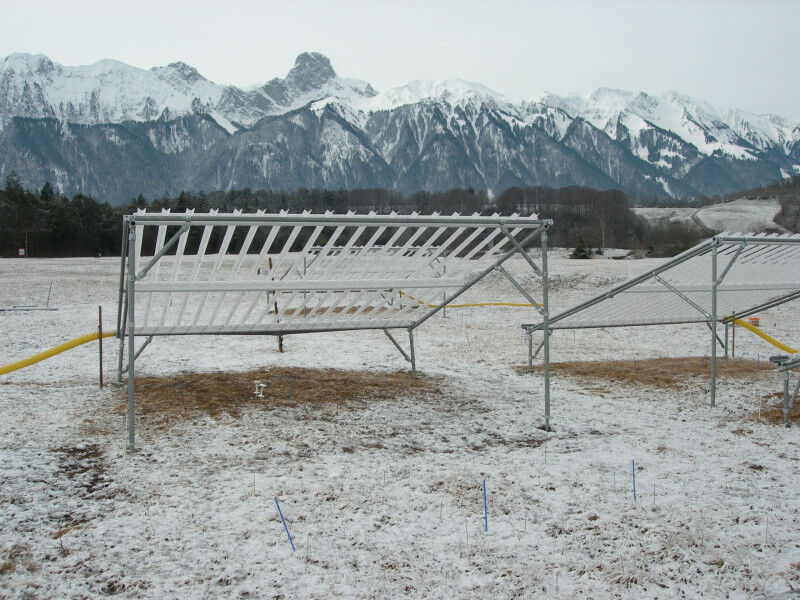
The researchers used special rain protection structures to simulate year-round droughts over a period of three to four years in order to measure their impact on the productivity of ecosystems. In addition to the duration, the intensity of such events was also taken into account. A ’1-in-100-year drought’ was used at each location - an extreme situation that is rare today but will become much more frequent in the future due to climate change.
ecologist Andreas Stampfli and ecologist Michaela Zeiter from the BFH-HAFL contributed data from their experiment in Thun. Andreas Stampfli explains: ’Of twelve meadow areas of the same size, six were covered with Plexiglas slats so that 33 percent less rain could reach the ground than usual’. This simulates exactly the driest of the last hundred years with an average annual precipitation. The function and species composition of the ecosystem was recorded before, during and after the simulated drought.
Together with the authors of the study, Andreas Stampfli and Michaela Zeiter warn: ’If droughts become longer and more severe in the future, ecosystems could lose their resilience. This is a warning signal for the future of many habitats.