An international research group involving the University of Bern has shown in the beaver lake near Marthalen that wetlands created by beavers store up to ten times more carbon than comparable landscapes without beavers. By damming rivers and retaining sediment, beavers transform streams into natural carbon reservoirs - with the potential to contribute to climate protection.
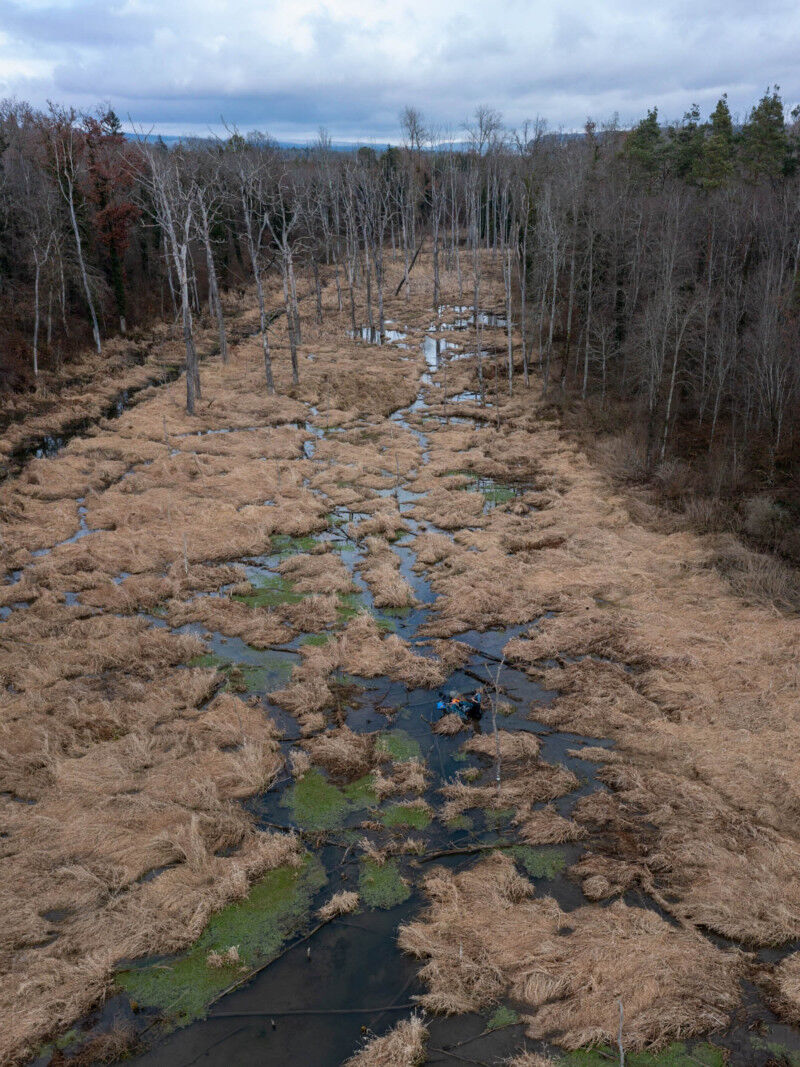
After decades of conservation efforts, beavers are increasingly returning to rivers and other natural landscapes across Europe. In 2007, for example, a family of beavers moved into the Niederholz near Marthalen in the canton of Zurich. They dammed the previously straight Mederbach and created a typical beaver landscape. What was once a small stream is now one of the largest beaver lakes in Switzerland.
An international research group led by the University of Birmingham, Wageningen University & Research, the University of Bern and other international partners has now carried out a study in this beaver lake to investigate the extent to which beavers change the carbon cycle through their building activities. Their results show: Beavers can transform riverbeds in a way that reduces the release of carbon dioxide into the air. The study, which has just been published in Communications Earth & Environment, is the first to provide a comprehensive carbon balance for wetlands created by beavers.
Ecosystem engineering services of beavers
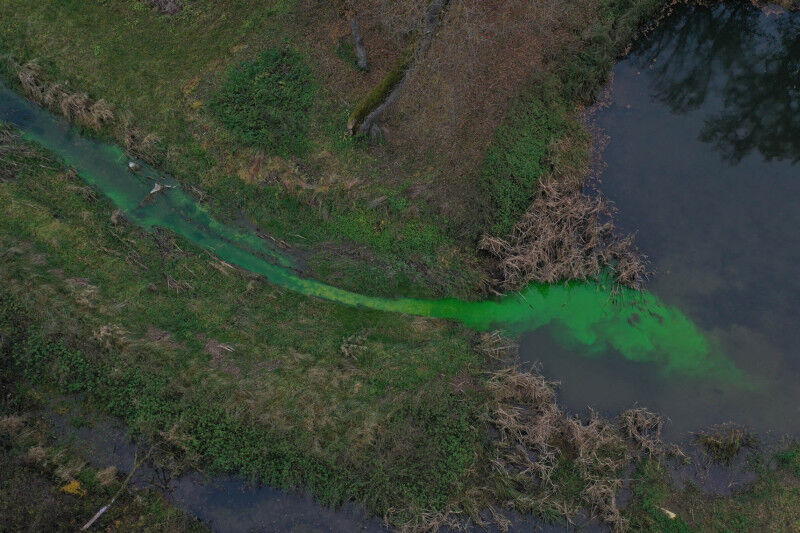
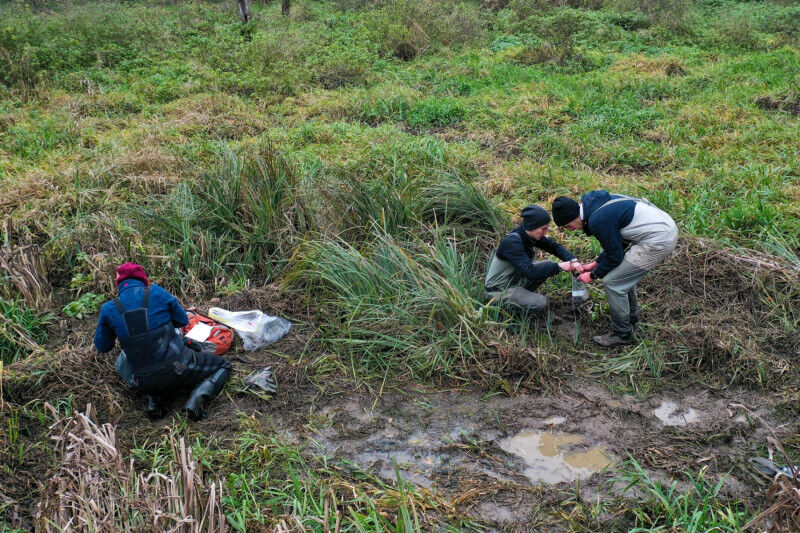
For their study, the researchers collected detailed data on water flows and chemical processes using soil samples and measurements of gases such as CO2. They combined this information with long-term calculations to create the most precise overview to date of how much carbon is stored in a beaver landscape in Switzerland.
With their investigations, the researchers were able to show that beavers significantly change the storage, circulation and retention of carbon in headwater systems - the small, upstream origins of rivers.
By building dams, beavers flood the floodplains, create wetlands, change the groundwater flow paths and retain large amounts of organic and inorganic material - i.e. plant and animal remains as well as mineral components such as sand, silt and clay - and thus also carbon. In doing so, beavers perform a so-called ecosystem engineering service: they reshape their surroundings through their natural behavior and thus act as ’master builders’ of the environment. The results of the study show that the wetlands created by beavers can store up to ten times more carbon than similar areas without beaver activity.
98.3 tons of carbon stored
Over a period of 13 years, an estimated 1,194 tons of carbon were stored in the wetland, which corresponds to 10.1 tons of carbon per hectare per year. ’These are very high values. Known measures in agriculture for long-term carbon storage in the soil usually result in less than 1 ton per hectare per year,’ explains Bettina Schaefli from the Institute of Geography at the University of Bern and co-author of the study. Dr. Joshua Larsen from the University of Birmingham, lead author of the study, explained: ’Our results show that beavers are not only changing landscapes, but also the way carbon moves through them. By slowing down water, retaining sediment and expanding wetlands, they are turning streams into powerful carbon sinks. This first-of-its-kind study represents a major opportunity and breakthrough for future nature-based climate solutions across Europe.
Due to the beaver activity in the area, the wetland acted as an annual net carbon sink - a system that absorbs and stores more carbon than it releases to the atmosphere - of 98.3 ± 33.4 tons of carbon per year. This means that on average 98.3 tons of carbon are stored per year, with an uncertainty of 33.4 tons upwards or downwards. This is mainly due to the fact that dissolved inorganic carbon is removed from the area via underground waterways and stored there.
Long-term carbon sink
The system designed by the beaver also showed clear seasonal patterns. ’In summer, when water levels decreased and exposed sediment surfaces increased, carbon dioxide emissions temporarily exceeded retention - the system became a short-term carbon source,’ says Schaefli. over the annual cycles, however, the accumulation of sediments, plants and dead wood caused by the beaver led to a significant storage of carbon. ’Methane (CH4) emissions in particular, which are often a major problem in wetlands, were found to be negligible and accounted for less than 0.1 percent of the carbon budget,’ says Schaefli. Dr. Lukas Hallberg from the University of Birmingham, the lead author of the study, says: ’In just over a decade, the system we studied has already turned into a long-term carbon sink, far beyond what we would expect from an unmanaged river corridor. This underlines the enormous potential of beaver revitalizations and provides valuable insights into potential land use planning, reforestation strategies and climate policy’.
Implications for future climate management
Over time, carbon in beaver-created wetlands is stored in accumulating sediments and dead wood. The researchers found that these sediments contain up to 14 times more inorganic carbon and eight times more organic carbon than the soils of the surrounding forests. The deadwood from the forests along rivers, streams and wetlands (riparian forests) accounted for almost half of the total carbon stored in the long term. These stores could persist for decades, suggesting that beaver-altered wetlands act as reliable, long-term carbon sinks - as long as their dams remain intact.
’We estimate that beaver wetlands could offset 1.2 to 1.8 percent of the country’s annual carbon emissions if they were extended to all floodplain areas suitable for beaver recolonization in Switzerland: ’They would benefit the climate without active human intervention or financial costs,’ says Schaefli.
As beaver populations continue to expand, further research to understand their role in shaping future ecosystems and future carbon budgets will be crucial.