The Climate University Event offered a compelling overview of how, in just a few years, sustainability thinking has been embraced at every organisational level. It also marked a new phase. Departing sustainability coordinator Andy van den Dobbelsteen said: -Thanks to our committed community, we can make TU Delft the world’s leading climate university, even with a smaller sustainability core team.-
Presenters Andy van den Dobbelsteen and Puck Wijnia would have loved for all 35,000 TU Delft students and staff to attend the event. But that wouldn’t have fit in the Co-Creation Centre of The Green Village - and, frankly, it wasn’t necessary. The two hours of professional videos and live interviews made one thing unmistakably clear: a strong wind of sustainability is sweeping through the university, from boardroom to coffee corner. Here are a few highlights.
Green Façade
As part of the Campus as a Living Lab initiative, several green façade systems have been installed at the Faculty of Civil Engineering and Geosciences. Equipped with numerous sensors, they act as a testbed for making the campus more climate-resilient, monitoring impacts on air quality, water management, and biodiversity. But the impact goes far beyond this, as everything is interconnected - from research to the campus, and out to society at large.
For example, researcher Rosa de Wolf of the Urban Ecology Design Lab explained that many more climate-adaptive design concepts are being tested across the campus. -We want to scale these up to the 3,800 business parks in the Netherlands. With the right greenery, these hard-surfaced, monotonous environments become more resilient to heat stress and gain both ecological and social value. This forms part of a national research programme, in which we work together with various educational institutions.-
Geothermal Energy
The geothermal source, including high-temperature heat storage, also sits at the intersection of research, on-campus Living Lab, and opportunities for scaling up to society. Furthermore, when it starts operating early next year, it will substantially reduce TU Delft-s total carbon footprint. -It is but one example of how we support both our world-class scientists and on-campus innovation,- explains Hubert Linssen of Campus Real Estate and Facility Management (CREFM). -This also involves facilitating innovations across the entire campus, which were first tested on a smaller scale at The Green Village. What could be more rewarding than accelerating the validation of these innovations while also achieving sustainability gains on campus?-
Community and Awareness
What stood out this afternoon is that the sustainability gains already achieved stem from dozens, if not hundreds, of initiatives, big and small. From the reuse of materials and building components in making buildings more sustainable to a circular procurement policy, from a more efficient use of space to a modified parking policy, and from sustainability coordinators at all faculties to wild bees and honey. What fuels all these initiatives is a passionate community and an ever-increasing awareness of sustainability.
GreenTU
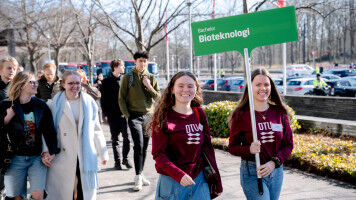
The presentation by Jeroen von Berg, representing GreenTU , made it clear that students themselves are a major driving force in these efforts. -All students have the ambition to work together and make a positive impact on their future, their campus, and their university, particularly in sustainability,- he explained. -For this reason, we have been connecting students with researchers, lecturers, and campus managers for the past ten years.-
He emphasized that the students played a pioneering role in developing TU Delft-s sustainability reports. And together with Monica Roeling, they created the Green Database, a one-stop resource listing all lectures that touch on the United Nations- Sustainable Development Goals.
By now, each faculty champions its own Green Team, where students - often teaming up with staff - bring small-scale sustainability projects to life across education, energy, waste, and mobility. For example, GreenBK (Faculty of Architecture and the Built Environment) has taken the initiative to make the waste stream from the model hall more sustainable, as Dean Dick van Gameren highlighted at the start of the event.
Two tons
Many small steps add up to a big impact, and over the past five years TU Delft has been able to cut its total carbon footprint by six per cent each year. The goal of a carbon-neutral TU Delft by 2030, including procurement and both domestic and international travel, remains unchanged. Reaching this goal is no small challenge, requiring measures such as a public transport pass for all TU Delft personnel, which Van den Dobbelsteen strongly advocates.
But the figure that really stood out this afternoon was the two tonnes from the #2Tons2Thrive awareness campaign. -Two tons is the annual carbon budget for every person on Earth to keep global warming below two degrees by 2050,- Yasemin Kural explained. -With this campaign, we present this complex issue in a way that doesn’t feel restrictive but instead highlights freedom and opportunity.- The campaign, featuring an accompanying film, aims to inspire everyone to make conscious choices, whether on campus or at home.
Perhaps you need a break after taking in all these highlights, but chances are they-ve ignited your curiosity and drive to get involved. In that case, do visit TU Delft’s sustainability hub , showcasing the university-s vision, objectives, organisation, activities, and news on sustainability. It also highlights how everyone, students and staff alike, can contribute to a more sustainable TU Delft.
Be sure to also watch the short, hilarious film -The Climate Fighters- (in Dutch). Made as a teaser for the MOOC series The Sustainable Organisation, based on TU Delft-s sustainability approach, it showcases backyard carbon offsetting and a young know-it-all - a playful invitation for you to join in.