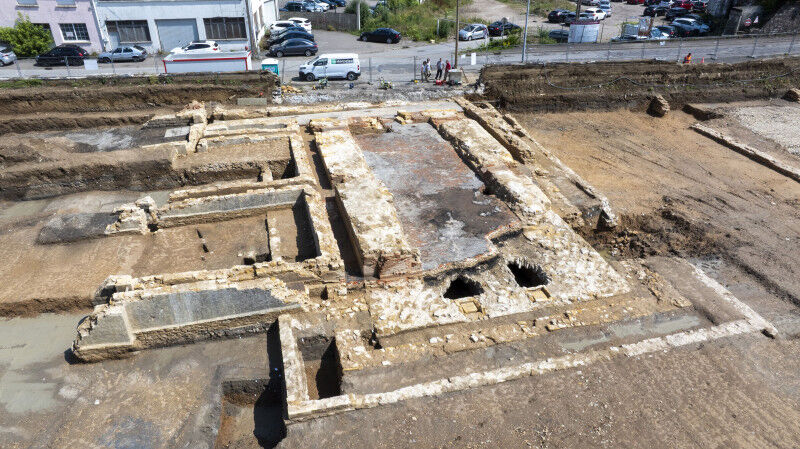
The right-of-way was affected by the construction in the 1960s of large high-rise buildings, known as the "Cormontaigne Towers", and their destruction in the 1990s. The excavation was part of the ZAC Cormontaigne expansion project, which aims to revitalize the area at the southern entrance to the city through the construction of a housing complex. It enabled us to observe and understand the internal organization of the bastion, from its construction integrating counter-mine galleries to the installation of a cartridge factory and a powder magazine established in the first half of the 19th century and modified several times until its demolition at the end of the first half of the 20th century.
The bastion
The bastion in question is part of the "crowned Yutz", which originally comprised three straight-sided bastions, two half-moons and two pincers, surrounded by dry ditches. This advanced system was linked to the town by two lock bridges spanning the Moselle diversion canal.
The ditch surrounding the bastion was spot-tested to observe the facing of the bastion escarpment. The bottom of the ditch is more than 5 m below the level of the escarpment.
The first state of the powder magazine
The hypothesis of an open-throated bastion communicating directly with the square was favoured, at least at the time the powder magazine was built around 1830, according to the sources. A retaining wall held back the earthworks of the rampart between the bastion escarpment and the powder magazine. The latter was built according to a standard plan. It is a rectangular building measuring 24 m x 10 m. The side walls, 2.30 m thick, have an ashlar base with chicane-shaped vents consisting of two straight segments at the ends and a central square stud. These vents isolate the powder from humidity and prevent direct fire in the event of an attack. The building is built on two parallel vaulted spaces acting as crawl spaces and ventilated by two vertical vents on each gable wall. The entire foundation rests on a system of crossbeams and wooden piles. A splinter wall surrounds the building, forming a parapet walk.The second state of the powder magazine
Developments in artillery technology at the end of the 19th century meant that the powder magazine had to be modified to withstand the test of bombs. These changes, which included burying the powder magazine, were carried out by the Germans during the Occupation. The original masonry cores were preserved, the baffle vents were condemned and new, more imposing ones were drilled into the walls to ensure the building’s ventilation with the outside world outside the embankments now covering the powder magazine. Galleries were also built all around the building, allowing both pedestrian circulation and additional ventilation. The floor of the gunpowder storage room, which was originally intended to be a floor of which no trace remains, was replaced by a brick floor covered with a layer of tar to provide additional insulation and avoid any risk of sparks when storing powder barrels.The cartridge factory
The remains of a cartridge factory could only be partially apprehended due to the impact of the construction of the towers in the 1960s. Only part of the west facade and the beginning of the return to the south have been uncovered, as well as the east facade observed in cross-section at the northern limit of the excavation. Its contemporaneity with either state of the powder magazine has not yet been established, but it appears on an early 20th-century German plan alongside the buried magazine.
The excavation has enabled us to understand the construction techniques and layout of the bastion and its internal fittings. This is a first for Thionville, which until now had only made occasional observations of modern fortifications during archaeological diagnostics. The operation also enabled us to observe the resources deployed to defend the town. The discovery and removal of foundation piles beneath the first state of the powder magazine will enable us to refine its estimated construction date in the second quarter of the 19th c.
Development : ADIM Est

Archaeological research: Inrap
Scientific manager: Sylvie Thomas, Inrap