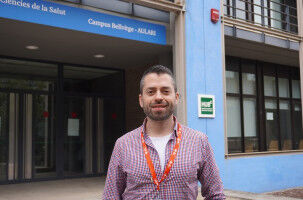
For Olivia Gerhard, a doctoral researcher at the Ilmenau School of Green Electronics, this special research journey began with a very personal question:
How can I combine my enthusiasm for biology with my passion for technology?
She found her first answers during her bachelor’s degree in Biomedical Engineering at TU Ilmenau, where she was able to connect her interest in biological systems with electrical engineering. For her bachelor’s thesis, Olivia Gerhard moved to an institute at the Karlsruhe Institute of Technology (KIT), where she investigated biosensors - tiny systems that make biomolecules quantitatively measurable:
That’s when I realized that, for what I was truly interested in, I mostly lacked deeper knowledge in chemistry.
Instead of continuing her studies at KIT, she therefore returned to Ilmenau to pursue a master’s degree in Biotechnical Chemistry, focusing on miniaturized technologies.
Research at the interface of biology and technology
The decisive moment that ultimately led her to the Ilmenau School of Green Electronics as a doctoral researcher came shortly before completing her master’s degree, during a conversation with Dr. Jialan Cao-Riehmer, junior research group leader in the Department of Physical Chemistry/Microreaction Technology, where Olivia had carried out her master’s thesis. She drew Olivia’s attention to the possibility of pursuing a doctorate at ISGE. For Olivia, it felt as if a missing puzzle piece had finally clicked into place:
This was exactly the intersection I had been looking for. Biology and technology - combined with the idea of sustainability. I was instantly fascinated.
At the core of Olivia’s research are microorganisms-so-called electrotrophic and exoelectrogenic bacteria-that possess a remarkable ability: they can take up and release electrons because their metabolism is based on electrochemical processes. Olivia aims to harness this property by connecting the bacteria with electronic components in such a way that they could eventually even be integrated directly into electronic circuits as active electrical elements-becoming "living electronic systems" that combine solid-state and biological functions.
Her doctoral supervisor, Professor Michael Köhler, explains:
Electronic systems operate essentially in a serial fashion, while biological systems like the brain are extremely interconnected and work in parallel. For more than 30 years, researchers have therefore been trying to link the electronic world with biological systems.
But nerve cells in the brain are highly complex. Bacteria, on the other hand, have a simpler structure-yet they are still electrically active. Prof. Köhler:
Our goal is to use this electrical activity of bacteria to enable electrical communication between them, so that, building on this, they might even be capable of performing logical operations.
Jialan Cao-Riehmer describes it like this:
I always imagine it as a large power grid in which our bacteria function like small power plants that form conductive structures to communicate with one another.
These natural "power plants," the team envisions, could one day become part of electronic circuits and a greener form of electronics. "So far, this field has barely been explored, which means our work is still very rudimentary," says Olivia Gerhard - and that is precisely what she finds so compelling about her research.
Can the bacteria’s metabolism be interconnected through electrodes?
For her research, Olivia Gerhard is first examining a well-studied model organism: Shewanella oneidensis - and for good reason, as the young researcher explains:
These bacteria use the sodium salt of lactic acid as an energy source and can transfer the excess electrons they generate to an electrode.
To allow these bacteria to grow on electrodes and connect them to electronic components in such a way that electrons can flow optimally across the interface, the doctoral researcher - supported by Prof. Martin Ziegler, head of the Energy Materials and Devices group at Kiel University - uses so-called thin-film technology:
With this technology and with the facilities at the Center for Microand Nanotechnologies (ZMN), we can build a microelectronic foundation that directly links the bacteria’s metabolism to the electronics.
In a second step, the ISGE team plans to use a mixed culture that both donates and accepts electrons, wiring these "power plants" together so that a kind of feedback loop - or even an oscillating signal - can emerge, forming a type of communication. Olivia Gerhard explains:
If we were able to measure such a signal and link it further, it would be a first step toward a living electrical communication network that we can control from the outside - similar to a learning system.
What Olivia Gerhard, Jialan Cao-Riehmer, Michael Köhler and Martin Ziegler are researching together is currently still absolutely basic research. But they have a vision, explains Prof. Köhler:
Our vision is to couple simple biological cells in such a way that sensing and even information processing become possible - ultimately creating a system sustained by biochemical processes, without the need to continuously apply external power.
What may sound like science fiction today could soon form the basis for electronic systems that are energy-efficient, flexible, and powered by living microorganisms. For Olivia, this is precisely what makes her doctoral work at the Ilmenau School of Green Electronics so exciting:
I find it incredibly fascinating that twelve doctoral researchers are working together here in a large-scale project, coming from very different fields yet sharing a common goal - even though the individual projects differ greatly: to develop a new kind of ’green,’ sustainable electronics. This interdisciplinary research and the opportunity to gain insights into a wide range of methods and technologies is incredibly enriching.