In the heart of the Marais Poitevin regional nature park, the second-largest wetland in France, a scientific team1 led by a CNRS researcher has demonstrated the ability of clay soils to self-organise into geometric patterns. Known as mottureaux, these microreliefs2, similar to hummocks, channel rainwater infiltration and promote plant biodiversity3 in marsh soils. These findings are published in the Journal of the Royal Society Interface on 25 March 2026.
Far from being formed randomly, mottureaux result from a twofold self-organisation process. During dry periods, a precise pattern of polygons forms between the cracks. When the wet season returns, fresh water infiltrates the saline clay soil, which swells and causes some of the polygons - mottureaux - to rise up, creating geometric patterns. The deep cracks play a decisive role by channelling rainwater infiltration. This lowers the salinity of the water in the deeper layers and thereby triggers uplift in the soil mounds4. The team also discovered that the movement of animal herds across these soils creates tracks that alter the mottureaux patterns, thus influencing how they are organised5.
These findings were established through drone survey campaigns conducted between 2019 and 2023, combining orthoimagery, spectral analyses, numerical modelling and soil analyses.
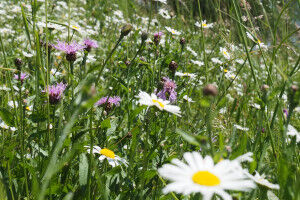
Shaped by these microreliefs, the wet grassland landscape proves to be an important reservoir of biodiversity. Vegetation is more diverse there, creating greater species richness than in flat grasslands. Protecting these fragile environments, which are threatened by the intensification of management practices such as agriculture and artificialisation, must be included in efforts to conserve both biological and geological natural heritage.
Notes:
1 - Working at the P’Institute: Physics and Engineering in Materials, Mechanics and Energy (CNRS), and at IC2MP: the Institut de Chimie des Milieux et Matériaux de Poitiers (CNRS/University of Poitiers). This collaborative work also involves scientists from the James Hutton Institute in Scotland, the Michel Brosselin National Nature Reserve and the LPO, a French non-profit for the protection of birds. This collective work is interdisciplinary and was supported by the CNRS.
2 - Mottureaux are mounds a few dozen centimetres across, arranged in regular square or hexagonal networks, and sometimes even in wavy patterns.
3 - Plant biodiversity encompasses all plant varieties worldwide, playing a key role in maintaining ecological functions and ecosystem resilience.
4 - This interplay shapes a constantly shifting landscape, where the configuration and management of water dictate the shapes of the patterns. The lower-lying areas contain channel ridges (folds), while the higher parts are covered in crystalline mesh patterns.
5 - The patterns can be re-positioned to transform wavy patterns in the soil into square networks.
Soils from marsh: self-organization of biogeomorphological paludal patterns, their potential formation mechanisms and ecological interest. Mélissa Marius, Fabien Hubert, Emmanuel Tertre, Élise Le Gouguec, Stephen Hillier, Anthony Beaudoin, Paméla Lagrange, Pierre de Bouët du Portal et Germain Rousseaux. Journal of the Royal Society Interface . 25 March 2026.
The data and associated resources are freely available on Zenodo: https://zenodo.org/records/18109270