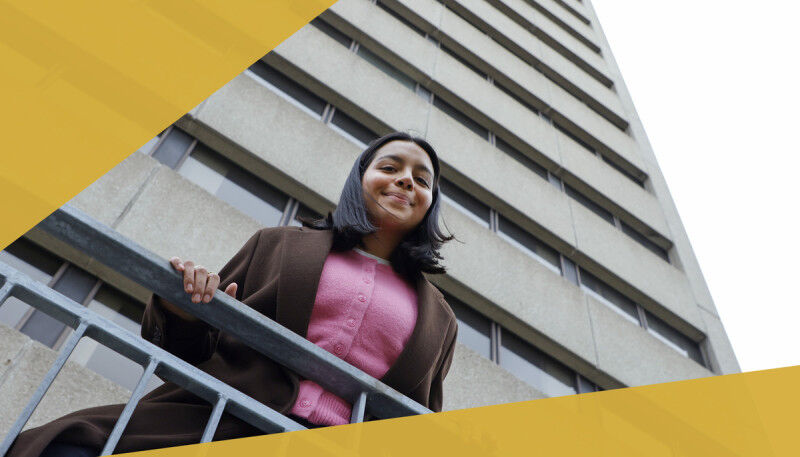
Ariane Therrien, a doctoral student in psychology, answers a question from the audience as part of the series La science, pas si compliquée!
Imagine yourself standing on the edge of a cliff, staring into space. Your hands become clammy, your heartbeat quickens and a strange feeling of imbalance washes over you. Why do some people feel this intense fear, while others remain perfectly at ease at heights? That’s the question Yuri asked himself.
Ariane Therrien, a doctoral candidate in psychology, answers:
"Vertigo and fear of heights are two phenomena that may be linked, but are distinct.
Vertigo is a physical sensation. We get the impression that our body or environment is moving. Often, we’ll feel that everything is spinning around us. In reality, the environment we’re in or our body isn’t really moving. Vertigo is a symptom in itself, and there are many possible causes: ear problems, lifestyle habits or health problems.
Fear of heights can be explained by a phobia known as "acrophobia". This is defined by a fear of heights that is much greater and more irrational than the actual danger. Acrophobia can intensify when we’re in a situation where it’s possible for us to see the void and there’s no protection between us and it (e.g. mountain hiking). It can also be triggered by the mere idea of being high up or seeing someone facing the void. Often, people will engage in avoidance behaviors that intensify this fear. This phobia can have various causes: traumatic events, certain psychological health disorders or upbringing.
What’s the link between the two? One may follow the other. Feelings of vertigo can increase acrophobia, given the unpleasant sensation of instability that leads to a feeling of insecurity. On the other hand, fear of heights can provoke significant signs of anxiety and lead to vertigo symptoms."
Interview by Matthieu Dessureault
The La science, pas si compliquée! series answers questions from the general public, captured in a video booth set up at the Musée de la civilisation, the Grand Marché de Québec, the Petit Champlain district and the campuses of Université Laval and the École de technologie supérieure. The series is part of the Knowledge, Science and Society project of the ULaval Institutional Plan 2023-2028