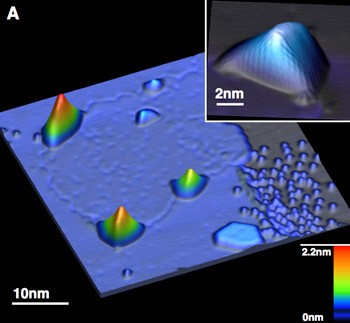
Scanning tunneling microscope image of a single layer of graphene on platinum with four nanobubbles at the graphene-platinum border and one in the patch interior. The inset shows a high-resolution image of a graphene nanobubble and its distorted honeycomb lattice due to strain in the bubble.
BERKELEY — Graphene, a sheet of pure carbon heralded as a possible replacement for silicon-based semiconductors, has been found to have a unique and amazing property that could make it even more suitable for future electronic devices. Physicists at the University of California, Berkeley, and the Lawrence Berkeley National Laboratory (LBNL) have found that when graphene is stretched in a specific way it sprouts nanobubbles in which electrons behave in a bizarre way, as if they are moving in a strong magnetic field. Scanning tunneling microscope image of a single layer of graphene on platinum with four nanobubbles at the graphene-platinum border and one in the patch interior. The inset shows a high-resolution image of a graphene nanobubble and its distorted honeycomb lattice due to strain in the bubble. (Crommie lab, UC Berkeley image) Specifically, the electrons within each nanobubble segregate into quantized energy levels instead of occupying energy bands, as in unstrained graphene. The energy levels are identical to those that an electron would occupy if it were moving in circles in a very strong magnetic field, as high as 300 tesla, which is bigger than any laboratory can produce except in brief explosions, said Michael Crommie, professor of physics at UC Berkeley and a faculty researcher at LBNL. Magnetic resonance imagers use magnets less than 10 tesla, while the Earth's magnetic field at ground level is 31 microtesla.
TO READ THIS ARTICLE, CREATE YOUR ACCOUNT
And extend your reading, free of charge and with no commitment.