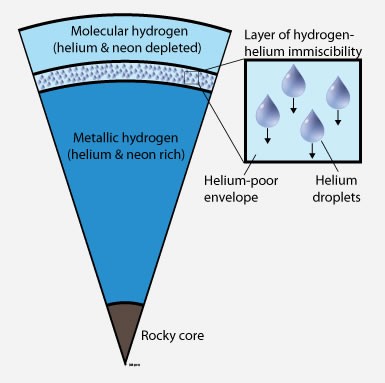
A slice through the interior of Jupiter shows the top layers that are depleted of helium and neon, the thin layer where helium drops condense and fall, and the deep interior where helium and neon again mix with metallic hydrogen. (Burkhard Militzer graphic)
A slice through the interior of Jupiter shows the top layers that are depleted of helium and neon, the thin layer where helium drops condense and fall, and the deep interior where helium and neon again mix with metallic hydrogen. Burkhard Militzer graphic) On Jupiter, however, UC Berkeley scientists claim that helium rain is the best way to explain the scarcity of neon in the outer layers of the planet, the solar system's largest. Neon dissolves in the helium raindrops and falls towards the deeper interior where it re-dissolves, depleting the upper layers of both elements, consistent with observations. "Helium condenses initially as a mist in the upper layer, like a cloud, and as the droplets get larger, they fall toward the deeper interior," said UC Berkeley post-doctoral fellow Hugh Wilson, co-author of a report appearing this week in the journal Physical Review Letters . "Neon dissolves in the helium and falls with it. So our study links the observed missing neon in the atmosphere to another proposed process, helium rain." Wilson's co-author, Burkhard Militzer, UC Berkeley assistant professor of earth and planetary science and of astronomy, noted that "rain" – the water droplets that fall on Earth – is an imperfect analogy to what happens in Jupiter's atmosphere. The helium droplets form about 10,000 to 13,000 kilometers (6,000-8,000 miles) below the tops of Jupiter's hydrogen clouds, under pressures and temperatures so high that "you can't tell if hydrogen and helium are a gas or a liquid," he said.
TO READ THIS ARTICLE, CREATE YOUR ACCOUNT
And extend your reading, free of charge and with no commitment.