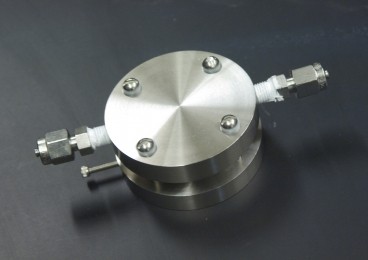
Test battery has inlet and outlet on the sides to provide a flow of air, providing oxygen for the battery’s operation. Photo: Patrick Gillooly/MIT
CAMBRIDGE, Mass. A team of researchers at MIT has made significant progress on a technology that could lead to batteries with up to three times the energy density of any battery that currently exists. Yang Shao-Horn, an MIT associate professor of mechanical engineering and materials science and engineering, says that many groups have been pursuing work on lithium-air batteries, a technology that has great potential for achieving great gains in energy density. But there has been a lack of understanding of what kinds of electrode materials could promote the electrochemical reactions that take place in these batteries. Lithium-oxygen (also known as lithium-air) batteries are similar in principle to the lithium-ion batteries that now dominate the field of portable electronics and are a leading contender for electric vehicles. But because lithium-air batteries replace the heavy conventional compounds in such batteries with a carbon-based air electrode and flow of air, the batteries themselves can be much lighter. That's why leading companies, including IBM and General Motors, have committed to major research initiatives on lithium-air technology.
TO READ THIS ARTICLE, CREATE YOUR ACCOUNT
And extend your reading, free of charge and with no commitment.