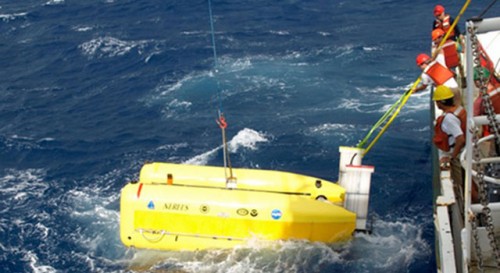
A team recovers the hybrid robotic vehicle Nereus aboard the research vessel Cape Hatteras during a partially NASA-funded expedition to the Mid-Cayman Rise in October 2009. A search for new hydrothermal vent sites along the 110-kilometer-long ridge, the expedition featured the first use of Nereus in "autonomous," or free-swimming, mode. Image credit: Woods Hole Oceanographic Institution
July 20, 2010 An expedition partially funded by NASA, part of a program to search extreme environments for geological, biological and chemical clues to the origins and evolution of life, has discovered the deepest known hydrothermal vent in the world, nearly 5,000 meters (16,400 feet) below the surface of the western Caribbean Sea. The research will help extend our understanding of the limits to which life can exist on Earth and help prepare for future efforts to search for life on other planets. An interdisciplinary team led by Woods Hole Oceanographic Institution, Woods Hole, Mass., and including research scientist Max Coleman of NASA's Jet Propulsion Laboratory, Pasadena, Calif., sailed to the western Caribbean in October 2009 aboard the research vessel Cape Hatteras. Using sensors mounted on equipment and robotic vehicles, they searched for deep-sea hydrothermal vents along the 110-kilometer-long (68-mile-long) Mid-Cayman Rise, an ultra-slow spreading ridge located in the Cayman Trough - the deepest point in the Caribbean Sea. Results of their research are published this week in the Proceedings of the National Academy of Sciences. While high-temperature submarine vents were first discovered more than 30 years ago, the majority of the global Mid-Ocean Ridge, an underwater mountain range that snakes its way for more than 56,000 kilometers (35,000 miles) between Earth's continents, remains unexplored for hydrothermal activity. While such activity occurs on spreading centers all around the world, scientists are particularly interested in Earth's ultra-slow spreading ridges, like the Mid-Cayman Rise, which may host systems that are particularly relevant to pre-biotic chemistry and the origins of life.
TO READ THIS ARTICLE, CREATE YOUR ACCOUNT
And extend your reading, free of charge and with no commitment.