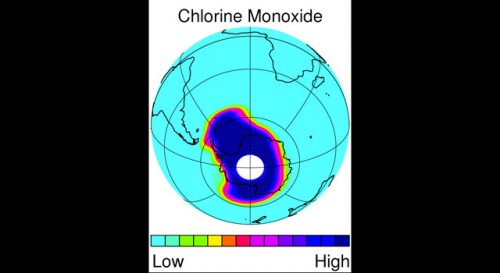
Map of chlorine monoxide, the primary agent of ozone destruction in the Antarctic ’ozone hole,’ as measured by the Microwave Limb Sounder instrument on NASA’s Aura satellite at an altitude of approximately 18 kilometers (11.2 miles) within the ozone layer.
Image credit: NASA/JPL
<a href=" Larger view
PASADENA, Calif. A new NASA study of Earth's polar ozone layer reinforces scientists' understanding of how human-produced chlorine chemicals involved in the destruction of ozone interact with each other. A team of scientists led by Michelle Santee of NASA's Jet Propulsion Laboratory, Pasadena, Calif., examined how nighttime temperatures affect chlorine monoxide, a key chemical involved in ozone destruction. Combining NASA satellite measurements with a state-of-the-art chemical model, they found this relationship to be more consistent with recent laboratory work than with some older laboratory and field observational data. This verification is important, because scientists have not been able to conduct appropriate laboratory experiments relevant to understanding how polar chlorine monoxide behaves at night at the lowest temperatures of the stratosphere, Earth's second lowest atmospheric layer. Santee and her team published their findings this month in the Proceedings of the National Academy of Sciences. The data came from the Microwave Limb Sounder instrument on NASA's Aura satellite.
TO READ THIS ARTICLE, CREATE YOUR ACCOUNT
And extend your reading, free of charge and with no commitment.