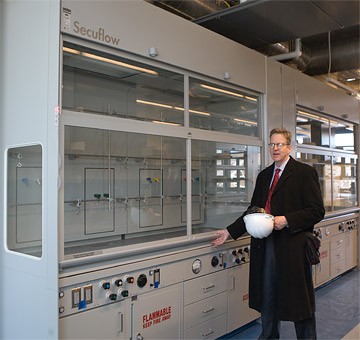
James Wallace, project manager in design and construction, demonstrates an automatic sash closer on one of the 200 high-efficiency fume hoods installed at work areas.
Tour reveals interactive nature of design While the sheer size of Princeton's new Chemistry Building is striking, the structure at the same time has a way of fusing with its surroundings - its glass façade reflecting the nearby woodlands and stream valley leading to Lake Carnegie. At 265,000 gross square feet, it will be the largest single academic building, excluding Firestone Library, on the University's campus when completed this fall after three years of construction. Architects and planners have optimized energy efficiency by incorporating state-of-the-art sustainability features throughout the structure. The exterior glazing, for example, has sunscreens to optimize ambient day-lighting of interior spaces while controlling heat gain. This system also will be linked with sensors to control dimmable electric lighting. The environmentally friendly facets extend to the surrounding building site, located east of Washington Road between Ivy Lane and Faculty Road just south of Jadwin Hall. The Washington Road stream will be restored, plantings along the road will help re-establish the woodlands that once filled this stream valley and landscaped "rain gardens" will provide biofiltration of stormwater.
TO READ THIS ARTICLE, CREATE YOUR ACCOUNT
And extend your reading, free of charge and with no commitment.