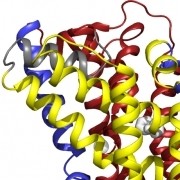
UK team reveals all three structures of a single transporter protein
Adapted from a press release issued by the University of Leeds - Friday 23 April 2010 A team of researchers from Imperial College London and the Universities of Leeds and Oxford has captured the 3D atomic models of a single transporter protein in each of its three main structural states, an achievement that has been a goal of researchers from around the world for over 25 years. The discovery offers remarkable insight into the function of one of the body's most fundamental processes - the movement of essential chemicals into cells of the body - and creates an opportunity to develop brand new drugs. Biologists have surmised that transporter proteins of this type, which sit in the cell membrane, carry molecules through the otherwise impermeable membrane by shifting between at least three distinct structural states, controlled by ion gradients. In the first state, there is an outward-facing cavity. A compound will enter this cavity and attach to a binding site whereupon the protein will move to a second state with the cargo locked inside. The third state is formed when the protein opens up a cavity on the inward-facing side to release the compound into the cell. The switch between outward and inward-facing sides works rather like a 'kissing gate' in which the cavity is either on one side or the other but there is never a direct channel through the whole protein.
TO READ THIS ARTICLE, CREATE YOUR ACCOUNT
And extend your reading, free of charge and with no commitment.