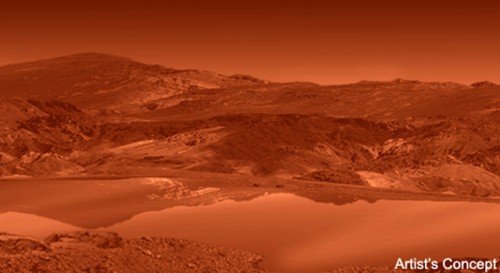
This artist concept shows a mirror-smooth lake on the surface of the smoggy moon Titan. Image credit: NASA/JPL
PASADENA, Calif. Two new papers based on data from NASA's Cassini spacecraft scrutinize the complex chemical activity on the surface of Saturn's moon Titan. While non-biological chemistry offers one possible explanation, some scientists believe these chemical signatures bolster the argument for a primitive, exotic form of life or precursor to life on Titan's surface. According to one theory put forth by astrobiologists, the signatures fulfill two important conditions necessary for a hypothesized "methane-based life." One key finding comes from a paper online now in the journal Icarus that shows hydrogen molecules flowing down through Titan's atmosphere and disappearing at the surface. Another paper online now in the Journal of Geophysical Research maps hydrocarbons on the Titan surface and finds a lack of acetylene. This lack of acetylene is important because that chemical would likely be the best energy source for a methane-based life on Titan, said Chris McKay, an astrobiologist at NASA Ames Research Center, Moffett Field, Calif., who proposed a set of conditions necessary for this kind of methane-based life on Titan in 2005. One interpretation of the acetylene data is that the hydrocarbon is being consumed as food.
TO READ THIS ARTICLE, CREATE YOUR ACCOUNT
And extend your reading, free of charge and with no commitment.