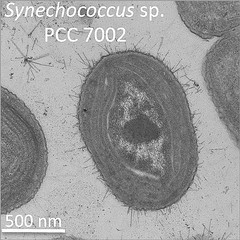
Penn State scientists have scoured this cyanobacterium's genome to discover genes that could make alternative energy-cycle enzymes for biofuels and plastics.
University pledges continued cooperation with NCAA inquiry Hotels to support RAINN over commencement weekend A message from President Rodney Erickson As lawmakers review child abuse laws, Erickson expresses support Blue out, canning efforts raise $47,000 to fight child abuse, rape A generally accepted, 44-year-old assumption about how certain kinds of bacteria make energy and synthesize cell materials has been shown to be incorrect by a team of scientists led by Donald Bryant, the Ernest C. Pollard Professor of Biotechnology at Penn State and a research professor in the Department of Chemistry and Biochemistry at Montana State University. The research, which will be published on Dec. 16, is expected to help scientists discover new ways of genetically engineering bacteria to manufacture biofuels - energy-rich compounds derived from biological sources. Many textbooks, which cite the 44-year-old interpretation as fact, likely will be revised as a result of the new discovery. Bryant explained that, in 1967, two groups of researchers concluded that an important energy-making cycle was incomplete in cyanobacteria - photosynthetic bacteria formerly known as blue-green algae. This energy-producing cycle - known as the tricarboxylic acid (TCA) cycle or the Krebs cycle - includes a series of chemical reactions that are used for metabolism by most forms of life, including bacteria, molds, protozoa and animals. This series of chemical reactions eventually leads to the production of ATP - molecules responsible for providing energy for cell metabolism.
TO READ THIS ARTICLE, CREATE YOUR ACCOUNT
And extend your reading, free of charge and with no commitment.