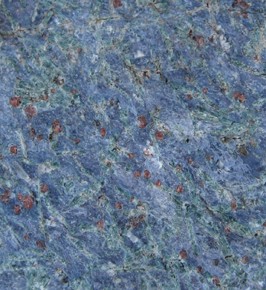
An "eclogite" rock that formed at a depth of approximately 80 km below the Earth's surface and which minerals contain the record of Yo-yo subduction.
New research from The Australian National University has shed light on the secrets of the deep Earth and will lead to better understanding of important geological processes. The research, carried out by Dr Daniela Rubatto and co-workers from the ANU Research School of Earth Sciences and colleagues at the University of Bern and University of Torino, has accurately recorded for the first time what was once considered purely theoretical - yo-yo subduction. Dr Rubatto said: 'Understanding subduction zones is critical as they are the areas where plates meet and merge, where volcanos form, where lava is generated and where earthquakes happen. This discovery also has the potential to change the way we look at plate collision zones and mountain building.' The ARC QEII Research Fellow added that the conventional view of subduction - zones where the Earth's crust is pushed down through the convergence of tectonic plates ' is that it happens only once. 'The typical idea is that the convergence of plates creates a force that pushes rocks down from the surface of the Earth making the whole system move down like a conveyor belt. Most of the material will sink forever in the planet's mantle and only a fraction will make it back to the surface. ?However we have now determined that the Earth's crust is pushed down from the planet's surface to a depth of 60 to 100 km, comes back towards the Earth's surface, is pushed down again and then finally ends up back on the surface where it becomes part of mountain belts.
TO READ THIS ARTICLE, CREATE YOUR ACCOUNT
And extend your reading, free of charge and with no commitment.