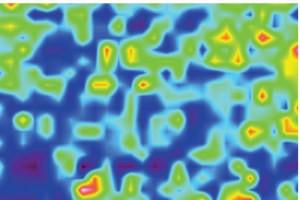
The infra-red image produced
The organic compounds surviving in fifty million year old fossilized reptile skin can be seen for the first time today, thanks to a stunning infra-red image produced by University of Manchester palaeontologists and geochemists. Published in the journal Royal Society Proceedings B , the brightly-coloured image shows the presence of amides - the organic compounds, or building blocks of life - in the ancient skin of a reptile, found in the 50 million year-old rocks of the Green River Formation in Utah, USA. This image had never been seen by the human eye, until a team led by Dr Roy Wogelius and Dr Phil Manning used state-of-the-art infra-red technology at The University of Manchester to reveal and map the fossilized soft tissue of a beautifully-preserved reptile. These infra-red maps are backed up by the first ever element-specific maps of organic material in fossil skin generated using X-rays at the Stanford synchrotron in the USA, also by the Manchester researchers. Chemical details are clear enough that the scientists, from the School of Earth, Atmospheric and Environmental Sciences, are even able to propose how this exceptional preservation occurs. When the original compounds in the skin begin to break down they can form chemical bonds with trace metals, and under exceptional conditions these trace metals act like a 'bridge' to minerals in the sediments. This protects the skin material from being washed away or decomposing further.
TO READ THIS ARTICLE, CREATE YOUR ACCOUNT
And extend your reading, free of charge and with no commitment.