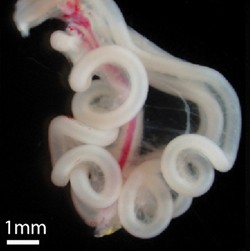
An embryonic chick gut at stage E16. Within a species, individuals of a given age will show the same number and size of gut loops. Photo courtesy of L. Mahadevan.
Mathematicians and biologists at Harvard explain why vertebrate intestines are so predictably loopy. Caroline Perry , (617) 496-1351 Between conception and birth, the human gut grows more than two meters long, looping and coiling within the tiny abdomen. Within a given species, the developing vertebrate gut always loops into the same formation'however, until now, it has not been clear why. Using a combination of experimental observations, biological and biophysical manipulations, theory, and computation, researchers at Harvard have shown that a "simple" balance of forces determines the form of the gut. The finding may shed light on how the gut has been able to evolve to accommodate changes in diet. The interdisciplinary research demonstrates that differences in growth rates between the gut tube and the neighboring mesenteric tissue force the tube to coil, regardless of the space constraints. 'One might think that the gut tube coils because it is restricted by the size of the abdominal cavity.
TO READ THIS ARTICLE, CREATE YOUR ACCOUNT
And extend your reading, free of charge and with no commitment.