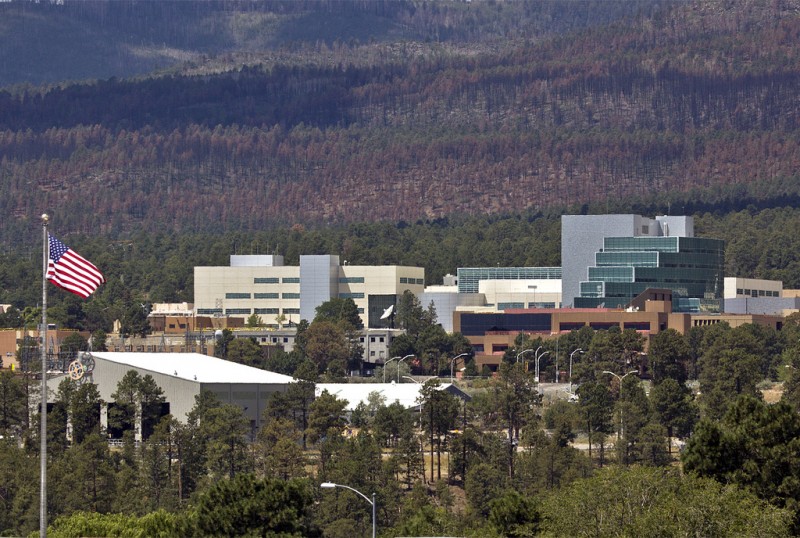
Los Alamos National Laboratory sits on top of a once-remote mesa in northern New Mexico with the Jemez mountains as a backdrop to research and innovation covering multi-disciplines from bioscience, sustainable energy sources, to plasma physics and new materials.
Most exciting is that the Los Alamos researchers have shown that blinking can be controlled and even completely suppressed electrochemically. LOS ALAMOS, New Mexico, November 9, 2011—Research by Los Alamos scientists published today documents significant progress in understanding the phenomenon of quantum-dot blinking. Their findings should enhance the ability of biologists to track single particles, enable technologists to create novel light-emitting diodes and single-photon sources, and boost efforts of energy researchers to develop new types of highly efficient solar cells. Most exciting is that the Los Alamos researchers have shown that blinking can be controlled and even completely suppressed electrochemically. As the article describes, the group developed a novel spectro-electrochemical experiment that allowed them to controllably charge and discharge a single quantum dot while monitoring its blinking behavior. These experiments facilitated the discovery of two distinct blinking mechanisms. "Our work is an important step in the development of nanostructures with stable, blinking-free properties for applications from light-emitting diodes and single-photon sources to solar cells," said Victor Klimov, LANL scientist and director of the Center for Advanced Solar Photophysics (CASP).
TO READ THIS ARTICLE, CREATE YOUR ACCOUNT
And extend your reading, free of charge and with no commitment.