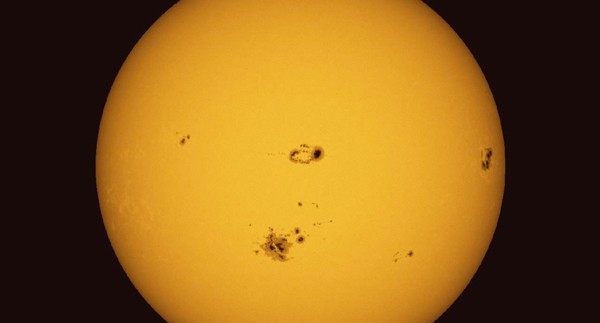
Stanford researchers have found a way to detect sunspots such as these two days before they reach the surface of the sun.
Sunspots spawn solar flares that can cause billions of dollars in damage to satellites, networks and power grids. But researchers have developed a way to detect incipient sunspots as deep as 65,000 kilometers inside the sun, providing up to two days' advance warning of a damaging solar flare. Viewed from the technological perspective of modern humans, the sun is a seething cauldron of disruptive influences that can wreak havoc on communication systems, air travel, power grids and satellites - not to mention astronauts in space. If disruptions such as solar flares and mass eruptions could be predicted, protective measures could be taken to shield vulnerable electronics before solar storms strike. Now Stanford researchers have developed a method that allows them to peer deep into the sun's interior, using acoustic waves to catch sunspots in the early stage of development and giving as much as two days' warning. Sunspots develop in active solar regions of strong, concentrated magnetic fields and appear dark when they reach the surface of the sun. Eruptions of the intense magnetic flux give rise to solar storms, but until now, no one has had luck in predicting them.
TO READ THIS ARTICLE, CREATE YOUR ACCOUNT
And extend your reading, free of charge and with no commitment.