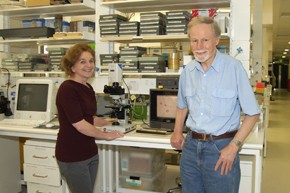
Dr Simeonovic and Parish. Photo by Karen Edwards.
Researchers from The Australian National University have discovered a new treatment for Type-1 diabetes - an autoimmune disease which currently affects some 130,000 Australians. Charmaine Simeonovic and Professor Christopher Parish from The John Curtin School of Medical Research have identified a previously unknown process which causes destruction of the insulin-producing beta cells in the pancreas. The researchers found that the insulin-producing cells need a complex sugar, heparan sulphate, for their survival. Beta cells are one of five cell types found in the pancreas and produce insulin - a hormone which helps move sugars from the food we eat into cells in our body for energy. In Type-1 diabetes the human body's immune system destroys these cells by mechanisms that are not well understood. Simeonovic said that their research has shown that beta cells found in the pancreas need heparan sulphate for their survival and without it they die. "We've discovered that replacement of heparan sulphate in the beta cells rescues the cells from dying and prevents them from damage caused by oxidation.
TO READ THIS ARTICLE, CREATE YOUR ACCOUNT
And extend your reading, free of charge and with no commitment.